
Textbook Question
Using only the periodic table as your guide, select the most electronegative atom in each of the following sets: (a) Se, Te, Br, I; (b) Be, Mg, C, Si (c) Al, Si, P, S (d) Zn, Ge, Ga, As.
545
views

 Verified step by step guidance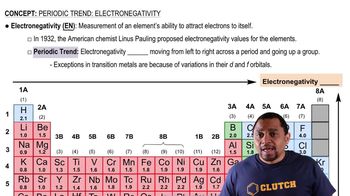
 02:10
02:10 02:10
02:10 00:38
00:38Using only the periodic table as your guide, select the most electronegative atom in each of the following sets: (a) Se, Te, Br, I; (b) Be, Mg, C, Si (c) Al, Si, P, S (d) Zn, Ge, Ga, As.
Which of the following bonds are polar: a. B—F, b. Cl—Cl, c. Se—O, d. H—I? Which is the more electronegative atom in each polar bond?
(b) How many bonding electrons are in the structure?
Using Lewis symbols and Lewis structures, diagram the formation of PF3 from P and F atoms, showing valence-shell electrons. (a) How many valence electrons does P have initially? (c) How many valence electrons surround the P in the PF3 molecule? (d) How many valence electrons surround each P in the PF3 molecule?
By referring only to the periodic table, select (d) the element in the group K, C, Zn, F that is most likely to form an ionic compound with Ba.
Which of the following statements about electronegativity is or are true? i. The alkali metals are the family with the largest electronegativity values. ii. The numerical values for electronegativity have no units. iii. Electronegativity is the ability of an atom in a molecule to attract electron density toward itself.