Using Lewis symbols and Lewis structures, diagram the formation of SiCl4 from Si and Cl atoms, showing valence-shell electrons. e. How many bonding pairs of electrons are in the SiCl4 molecule?
Ch.8 - Basic Concepts of Chemical Bonding

Brown15th EditionChemistry: The Central ScienceISBN: 9780137542970Not the one you use?Change textbook
Chapter 8, Problem 36a,c,d
Using Lewis symbols and Lewis structures, diagram the formation of PF3 from P and F atoms, showing valence-shell electrons. (a) How many valence electrons does P have initially? (c) How many valence electrons surround the P in the PF3 molecule? (d) How many valence electrons surround each P in the PF3 molecule?
Verified step by step guidance1
Identify the number of valence electrons for each atom: Phosphorus (P) has 5 valence electrons, and each Fluorine (F) atom has 7 valence electrons.
Draw the Lewis symbol for Phosphorus (P) with 5 dots around it, representing its 5 valence electrons.
Draw the Lewis symbol for each Fluorine (F) atom with 7 dots around it, representing its 7 valence electrons.
Form bonds by pairing unpaired electrons: Phosphorus will share one of its unpaired electrons with an unpaired electron from each of the three Fluorine atoms, forming three P-F single bonds.
Count the total number of valence electrons around the Phosphorus atom in the PF_3 molecule: After forming the bonds, Phosphorus will have 8 electrons in its valence shell, satisfying the octet rule.

Verified video answer for a similar problem:
This video solution was recommended by our tutors as helpful for the problem above.
Video duration:
1mWas this helpful?
Key Concepts
Here are the essential concepts you must grasp in order to answer the question correctly.
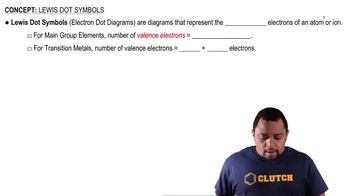
Lewis Symbols
Lewis symbols represent the valence electrons of an atom as dots surrounding the element's symbol. Each dot corresponds to a valence electron, allowing for a visual representation of how atoms bond and share electrons. This concept is crucial for understanding the formation of molecules, as it helps predict how atoms will interact based on their electron configurations.
Recommended video:
Guided course
Lewis Dot Symbols
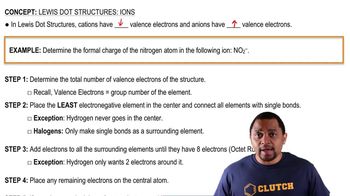
Lewis Structures
Lewis structures are diagrams that depict the arrangement of atoms and the distribution of valence electrons in a molecule. They illustrate how atoms are bonded together and show lone pairs of electrons. By using Lewis structures, one can visualize the connectivity and electron sharing in molecules like PF3, which is essential for understanding molecular geometry and reactivity.
Recommended video:
Guided course
Lewis Dot Structures: Ions
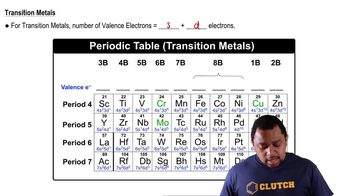
Valence Electrons
Valence electrons are the outermost electrons of an atom and are involved in chemical bonding. The number of valence electrons determines how an atom can bond with others, influencing the molecule's structure and properties. In PF3, phosphorus has five valence electrons, and each fluorine contributes one, leading to a total of eight electrons around phosphorus in the molecule.
Recommended video:
Guided course
Transition Metals Valence Electrons
Related Practice
Textbook Question
2
views
Textbook Question
(a) Based on the lattice energies of MgCl2 and SrCl2 given in Table 8.1, what is the range of values that you would expect for the lattice energy of CaCl2?
1342
views
Textbook Question
Place the following pairs of elements in order from smallest to largest difference in electronegativity: K and F, S and O, Br and I, Ca and Se, Li and Cl.
Textbook Question
(b) How many bonding electrons are in the structure?
1021
views
Textbook Question
Which of the following statements about electronegativity is or are true? i. The alkali metals are the family with the largest electronegativity values. ii. The numerical values for electronegativity have no units. iii. Electronegativity is the ability of an atom in a molecule to attract electron density toward itself.
1
views