
Ch.8 - Basic Concepts of Chemical Bonding
Brown - Chemistry: The Central Science 15th Edition
Brown15th EditionChemistry: The Central ScienceISBN: 9780137542970Not the one you use?Change textbook
Chapter 8, Problem 34

Which of these elements are unlikely to form ionic bonds: Mg, Al, Si, Br, I?

Verified step by step guidance
1
Step 1: Understand the nature of ionic bonds. Ionic bonds are formed between metals and non-metals where electrons are transferred from the metal to the non-metal, resulting in the formation of positively charged cations and negatively charged anions.
Step 2: Identify the elements given in the problem. The elements are Mg (Magnesium), Al (Aluminum), Si (Silicon), Br (Bromine), and I (Iodine).
Step 3: Classify each element as a metal, non-metal, or metalloid. Mg and Al are metals, Si is a metalloid, and Br and I are non-metals.
Step 4: Determine the likelihood of each element forming ionic bonds. Metals like Mg and Al tend to lose electrons and form cations, making them likely to form ionic bonds with non-metals. Non-metals like Br and I tend to gain electrons and form anions, also making them likely to form ionic bonds with metals.
Step 5: Consider the metalloid Si. Metalloids have properties intermediate between metals and non-metals and are less likely to form ionic bonds. Instead, they often form covalent bonds. Therefore, Si is unlikely to form ionic bonds.

Key Concepts

Here are the essential concepts you must grasp in order to answer the question correctly.

Ionic Bonds

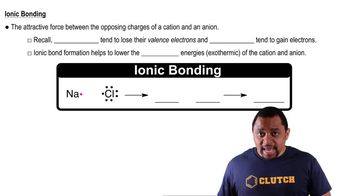
Ionic bonds are formed when one atom donates an electron to another, resulting in the creation of positively and negatively charged ions. This typically occurs between metals, which lose electrons, and nonmetals, which gain electrons. The electrostatic attraction between these oppositely charged ions holds them together in a compound.
Recommended video:
Guided course
01:49
Chemical Bonds

Electronegativity

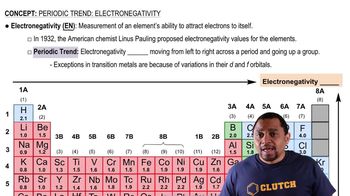
Electronegativity is a measure of an atom's ability to attract and hold onto electrons in a chemical bond. Elements with high electronegativity, such as nonmetals, are more likely to gain electrons and form ionic bonds with metals. Conversely, elements with low electronegativity are less likely to form ionic bonds, as they do not readily accept electrons.
Recommended video:
Guided course
02:10
Electronegativity Trends

Metallic vs. Nonmetallic Character

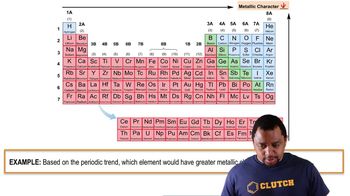
The metallic character of an element refers to its tendency to lose electrons and form positive ions, while nonmetallic character indicates a tendency to gain electrons. Metals like magnesium (Mg) and aluminum (Al) are more likely to form ionic bonds due to their metallic nature, whereas elements like silicon (Si), bromine (Br), and iodine (I) exhibit more nonmetallic characteristics, making them less likely to form ionic bonds.
Recommended video:
Guided course
00:56
Metallic Character Example
Related Practice
Textbook Question

Energy is required to remove two electrons from Ca to form Ca2+, and energy is required to add two electrons to O to form O2 - . Yet CaO is stable relative to the free elements. Which statement is the best explanation? (a) The lattice energy of CaO is large enough to overcome these processes. (b) CaO is a covalent compound, and these processes are irrelevant. (c) CaO has a higher molar mass than either Ca or O. (d) The enthalpy of formation of CaO is small. (e) CaO is stable to atmospheric conditions.

1093
views
Textbook Question

List the individual steps used in constructing a Born–Haber cycle for the formation of BaI2 from the elements. Which of the steps would you expect to be exothermic?

1089
views
Textbook Question

Using Lewis symbols and Lewis structures, diagram the formation of SiCl4 from Si and Cl atoms, showing valence-shell electrons. e. How many bonding pairs of electrons are in the SiCl4 molecule?

2
views
Textbook Question

(a) Based on the lattice energies of MgCl2 and SrCl2 given in Table 8.1, what is the range of values that you would expect for the lattice energy of CaCl2?

1342
views
Textbook Question

(b) How many bonding electrons are in the structure?

1021
views
Textbook Question

Using Lewis symbols and Lewis structures, diagram the formation of PF3 from P and F atoms, showing valence-shell electrons. (a) How many valence electrons does P have initially? (c) How many valence electrons surround the P in the PF3 molecule? (d) How many valence electrons surround each P in the PF3 molecule?

994
views