The figure that follows contains ball-and-stick drawings of three possible shapes of an AF4 molecule. (a) For each shape, give the electron-domain geometry on which the molecular geometry is based. i.
Ch.9 - Molecular Geometry and Bonding Theories

Brown15th EditionChemistry: The Central ScienceISBN: 9780137542970Not the one you use?Change textbook
Chapter 9, Problem 25c
Give the electron-domain and molecular geometries for the following molecules and ions: c. SF4
Verified step by step guidance1
Identify the central atom in the molecule. For SF₄, the central atom is sulfur (S).
Determine the total number of valence electrons in the molecule. Sulfur has 6 valence electrons, and each fluorine has 7 valence electrons. Calculate the total: 6 + (4 * 7).
Use the valence shell electron pair repulsion (VSEPR) theory to determine the electron-domain geometry. Count the number of electron domains (bonding and non-bonding) around the central atom. SF₄ has 4 bonding pairs and 1 lone pair.
Based on the number of electron domains, determine the electron-domain geometry. With 5 electron domains, the electron-domain geometry is trigonal bipyramidal.
Determine the molecular geometry by considering the positions of the atoms only (ignoring lone pairs). With 4 bonding pairs and 1 lone pair, the molecular geometry of SF₄ is seesaw.

Verified video answer for a similar problem:
This video solution was recommended by our tutors as helpful for the problem above.
Video duration:
1mWas this helpful?
Key Concepts
Here are the essential concepts you must grasp in order to answer the question correctly.
Electron-Domain Geometry
Electron-domain geometry refers to the spatial arrangement of all electron domains (bonding and lone pairs) around a central atom. It helps predict the overall shape of the molecule based on the number of regions of electron density. For SF4, the central sulfur atom has five electron domains, leading to a specific geometry.
Molecular Geometry
Molecular geometry describes the three-dimensional arrangement of the atoms in a molecule, considering only the positions of the nuclei. It is influenced by the electron-domain geometry but focuses on the actual atoms rather than electron pairs. In the case of SF4, the molecular geometry is determined by the positions of the sulfur and fluorine atoms.
Recommended video:
Guided course
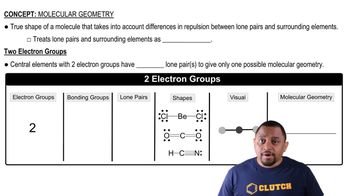
Molecular Geometry with Two Electron Groups
VSEPR Theory
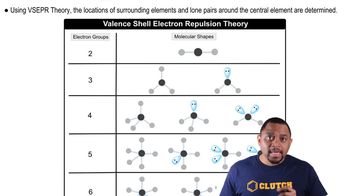
Valence Shell Electron Pair Repulsion (VSEPR) theory is a model used to predict the geometry of molecules based on the repulsion between electron pairs. According to VSEPR, electron pairs will arrange themselves to minimize repulsion, leading to specific shapes. For SF4, VSEPR helps explain why the molecule adopts a see-saw shape due to the presence of one lone pair.
Recommended video:
Guided course
Molecular Shapes and VSEPR
Related Practice
Textbook Question
857
views
Textbook Question
In which of the following molecules can you confidently predict the bond angles about the central atom, and for which would you be a bit uncertain? Explain in each case. (a) H2S, (b) BCl3, (c) CH3I, (d) CBr4, (e) TeBr4.
1245
views
Textbook Question
The figure that follows contains ball-and-stick drawings of three possible shapes of an AF4 molecule. (a) For each shape, give the electron-domain geometry on which the molecular geometry is based. ii.
364
views
Textbook Question
The figure that follows contains ball-and-stick drawings of three possible shapes of an AF4 molecule. (c) Which of the following elements will lead to an AF4 molecule with the shape in (iii): Be, C, S, Se, Si, Xe? i.
ii.
iii.
852
views