In the formate ion, HCO2-, the carbon atom is the central atom with the other three atoms attached to it. (d) How many electrons are in the p system of the ion?
Ch.9 - Molecular Geometry and Bonding Theories

Brown15th EditionChemistry: The Central ScienceISBN: 9780137542970Not the one you use?Change textbook
Chapter 9, Problem 67b
Predict the molecular geometry of each of the following molecules: (b) H O C O C O O H

Verified step by step guidance1
Identify the central atoms in the molecule. In this case, the central atoms are carbon (C) and nitrogen (N).
Determine the number of electron groups around each central atom. For carbon (C), there are three groups: one double bond with oxygen (O), one single bond with hydrogen (H), and one single bond with nitrogen (N). For nitrogen (N), there are four groups: one lone pair, two single bonds with hydrogen (H), and one single bond with carbon (C).
Use the VSEPR (Valence Shell Electron Pair Repulsion) theory to predict the molecular geometry. For carbon (C) with three electron groups, the geometry is trigonal planar. For nitrogen (N) with four electron groups, the geometry is tetrahedral.
Adjust the geometry for lone pairs. For nitrogen (N), the presence of one lone pair changes the tetrahedral geometry to a trigonal pyramidal geometry.
Summarize the molecular geometries: Carbon (C) has a trigonal planar geometry, and nitrogen (N) has a trigonal pyramidal geometry.
Key Concepts
Here are the essential concepts you must grasp in order to answer the question correctly.
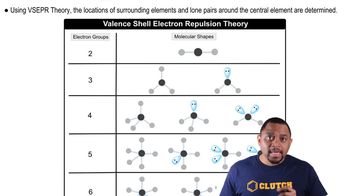
VSEPR Theory
Valence Shell Electron Pair Repulsion (VSEPR) Theory is a model used to predict the geometry of individual molecules based on the repulsion between electron pairs in the valence shell of the central atom. According to VSEPR, electron pairs will arrange themselves as far apart as possible to minimize repulsion, leading to specific molecular shapes such as linear, trigonal planar, or tetrahedral.
Recommended video:
Guided course
Molecular Shapes and VSEPR
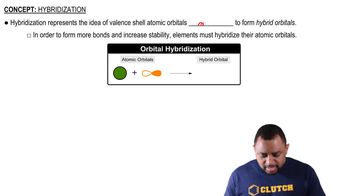
Hybridization
Hybridization is the concept of mixing atomic orbitals to form new hybrid orbitals that can accommodate the bonding and lone pairs of electrons in a molecule. For example, in the case of carbon in the given molecule, sp2 hybridization occurs, resulting in a trigonal planar arrangement around the carbon atom, which influences the overall molecular geometry.
Recommended video:
Guided course
Hybridization
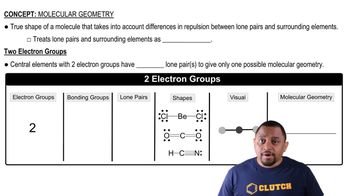
Molecular Geometry
Molecular geometry refers to the three-dimensional arrangement of atoms within a molecule. It is determined by the number of bonding pairs and lone pairs of electrons around the central atom, which affects the angles between bonds and the overall shape. Understanding molecular geometry is crucial for predicting the physical and chemical properties of substances.
Recommended video:
Guided course
Molecular Geometry with Two Electron Groups
Related Practice
Textbook Question
742
views
Textbook Question
In the formate ion, HCO2-, the carbon atom is the central atom with the other three atoms attached to it. (c) Are there multiple equivalent resonance structures for the ion?
1366
views
Textbook Question
Consider the H2+ ion. (c) Write the electron configuration of the ion in terms of its MOs. (d) What is the bond order in H2+?
883
views
Textbook Question
Consider the following Lewis structure:
a. Does the Lewis structure depict a neutral molecule or an ion? If it is an ion, what is the charge on the ion?
2
views
Textbook Question
What hybridization do you expect for the atom indicated in red in each of the following species? (a) CH3CO2-
2
views
Textbook Question
Consider the H2+ ion. (a) Sketch the molecular orbitals of the ion and draw its energy-level diagram.
888
views