In the formate ion, HCO2-, the carbon atom is the central atom with the other three atoms attached to it. (d) How many electrons are in the p system of the ion?
Ch.9 - Molecular Geometry and Bonding Theories

Brown15th EditionChemistry: The Central ScienceISBN: 9780137542970Not the one you use?Change textbook
Chapter 9, Problem 68a
What hybridization do you expect for the atom indicated in red in each of the following species? (a) CH3CO2-
Verified step by step guidance1
Identify the atom in red: In the given species CH3CO2-, the atom in red is likely one of the carbon atoms.
Determine the number of sigma bonds: Count the number of sigma (\(\sigma\)) bonds formed by the red atom. Each single bond is a sigma bond.
Count lone pairs: Determine if there are any lone pairs of electrons on the red atom.
Use the steric number to find hybridization: The steric number is the sum of sigma bonds and lone pairs. Use this number to determine hybridization: 2 = sp, 3 = sp2, 4 = sp3.
Apply to the red atom: Based on the steric number, assign the hybridization to the red atom in CH3CO2-.

Verified video answer for a similar problem:
This video solution was recommended by our tutors as helpful for the problem above.
Video duration:
2mWas this helpful?
Key Concepts
Here are the essential concepts you must grasp in order to answer the question correctly.
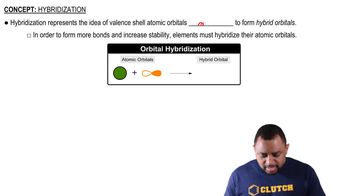
Hybridization
Hybridization is the concept of mixing atomic orbitals to form new hybrid orbitals that can accommodate the bonding requirements of an atom. It helps explain the geometry of molecular structures by determining the arrangement of electron pairs around a central atom. Common types of hybridization include sp, sp2, and sp3, which correspond to different molecular geometries.
Recommended video:
Guided course
Hybridization
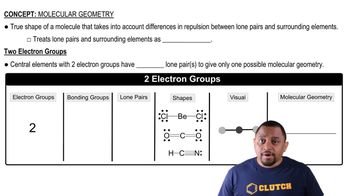
Molecular Geometry
Molecular geometry refers to the three-dimensional arrangement of atoms within a molecule. It is influenced by the number of bonding pairs and lone pairs of electrons around the central atom, which can be predicted using the VSEPR (Valence Shell Electron Pair Repulsion) theory. Understanding molecular geometry is crucial for predicting the shape and reactivity of molecules.
Recommended video:
Guided course
Molecular Geometry with Two Electron Groups
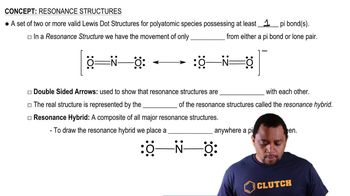
Resonance Structures
Resonance structures are different ways of drawing the same molecule that illustrate the delocalization of electrons. In species like CH3CO2-, resonance helps to depict the distribution of charge and the equivalent nature of bonds. Recognizing resonance is important for understanding the stability and reactivity of molecules, as it affects hybridization and molecular geometry.
Recommended video:
Guided course
Resonance Structures
Related Practice
Textbook Question
742
views
Textbook Question
Consider the H2+ ion. (c) Write the electron configuration of the ion in terms of its MOs. (d) What is the bond order in H2+?
883
views
Textbook Question
Consider the following Lewis structure:
a. Does the Lewis structure depict a neutral molecule or an ion? If it is an ion, what is the charge on the ion?
2
views
Textbook Question
Consider the H2+ ion. (e) Suppose that the ion is excited by light so that an electron moves from a lower-energy to a higher-energy MO. Would you expect the excited-state H2+ ion to be stable or to fall apart?
1007
views
1
rank
Textbook Question
Consider the H2+ ion. (a) Sketch the molecular orbitals of the ion and draw its energy-level diagram.
888
views
Textbook Question
Predict the molecular geometry of each of the following molecules: (b) H O C O C O O H
650
views