What is the hybridization of the central atom in a. SiCl4?
Ch.9 - Molecular Geometry and Bonding Theories

Brown15th EditionChemistry: The Central ScienceISBN: 9780137542970Not the one you use?Change textbook
Chapter 9, Problem 52c
What is the hybridization of the central atom in c. SO3?
Verified step by step guidance1
Identify the central atom in the molecule. In \( \text{SO}_3 \), the central atom is sulfur (S).
Determine the number of valence electrons for the central atom. Sulfur has 6 valence electrons.
Count the number of atoms bonded to the central atom. In \( \text{SO}_3 \), sulfur is bonded to three oxygen atoms.
Check for any lone pairs on the central atom. In \( \text{SO}_3 \), sulfur does not have any lone pairs as all valence electrons are used in bonding.
Use the steric number (number of bonded atoms + lone pairs) to determine hybridization. A steric number of 3 corresponds to \( sp^2 \) hybridization.

Verified video answer for a similar problem:
This video solution was recommended by our tutors as helpful for the problem above.
Video duration:
43sWas this helpful?
Key Concepts
Here are the essential concepts you must grasp in order to answer the question correctly.
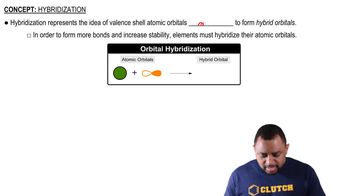
Hybridization
Hybridization is a concept in chemistry that describes the mixing of atomic orbitals to form new hybrid orbitals. These hybrid orbitals are used to explain the geometry and bonding properties of molecules. The type of hybridization depends on the number of electron pairs around the central atom, influencing molecular shape and bond angles.
Recommended video:
Guided course
Hybridization
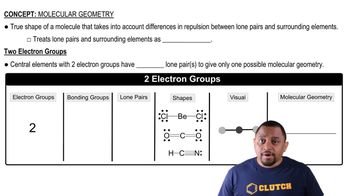
Molecular Geometry
Molecular geometry refers to the three-dimensional arrangement of atoms within a molecule. It is determined by the number of bonding pairs and lone pairs of electrons around the central atom. Understanding molecular geometry is crucial for predicting the shape of a molecule, which in turn affects its reactivity and properties.
Recommended video:
Guided course
Molecular Geometry with Two Electron Groups
Valence Shell Electron Pair Repulsion (VSEPR) Theory
VSEPR theory is a model used to predict the geometry of individual molecules based on the repulsion between electron pairs in the valence shell of the central atom. According to this theory, electron pairs will arrange themselves as far apart as possible to minimize repulsion, which helps determine the hybridization and shape of the molecule.
Recommended video:
Guided course
Valence Shell Electron Pair Repulsion Theory
Related Practice
Textbook Question
3
views
Textbook Question
Which of the following statements are true? d. A 𝜋 bond has two regions of overlap on opposite sides of the internuclear axis.
3
views
Textbook Question
Indicate the hybridization of the central atom in d. GeH4.
2
views
Textbook Question
Indicate the hybridization of the central atom in b. AlCl4–
3
views
Textbook Question
(b) Imagine that you could hold two atoms that are bonded together, twist them, and not change the bond length. Would it be easier to twist (rotate) around a single s bond or around a double 1s plus p2 bond, or would they be the same?
515
views
Textbook Question
Shown here are three pairs of hybrid orbitals, with each set at a characteristic angle. For each pair, determine the type of hybridization, if any, that could lead to hybrid orbitals at the specified angle. (a)
(b)
(c)
750
views