Answer the following questions. (c) A certain type of wood has a density of 0.40 g/cm3. What is the mass of 1.0 cord of this wood in kg, where 1 cord is 128 cubic feet of wood?
Ch.1 - Chemical Tools: Experimentation & Measurement
Chapter 1, Problem 111d
Answer the following questions. (d) A particular sample of crude oil has a density of 0.85 g/mL. What is the mass of 1.00 barrel of this crude oil in kg, where a barrel of oil is exactly 42 gallons?
Verified step by step guidance1
Convert the volume of 1 barrel from gallons to milliliters using the conversion factor: 1 gallon = 3,785.41 mL.
Calculate the total volume in milliliters by multiplying 42 gallons by the conversion factor.
Use the density formula, \( \text{Density} = \frac{\text{Mass}}{\text{Volume}} \), to find the mass in grams. Rearrange the formula to \( \text{Mass} = \text{Density} \times \text{Volume} \).
Substitute the density (0.85 g/mL) and the total volume in milliliters into the mass formula to calculate the mass in grams.
Convert the mass from grams to kilograms by dividing the mass in grams by 1,000, since 1 kg = 1,000 g.

Verified video answer for a similar problem:
This video solution was recommended by our tutors as helpful for the problem above.
Video duration:
1mWas this helpful?
Key Concepts
Here are the essential concepts you must grasp in order to answer the question correctly.
Density
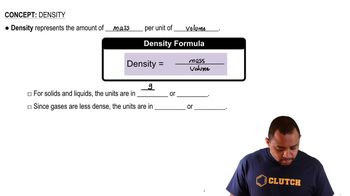
Density is defined as mass per unit volume, typically expressed in grams per milliliter (g/mL) or kilograms per cubic meter (kg/m³). It is a crucial property that helps determine how much mass is contained in a given volume of a substance. In this question, the density of crude oil is given as 0.85 g/mL, which will be used to calculate the mass of the oil based on its volume.
Recommended video:
Guided course
Density Concepts
Volume Conversion
Volume conversion involves changing a measurement from one unit to another, which is essential when dealing with different systems of measurement. In this case, the volume of crude oil is given in barrels, and we need to convert it to a compatible unit (milliliters or liters) to use the density for mass calculation. Knowing that 1 barrel equals 42 gallons and that 1 gallon is approximately 3.78541 liters will facilitate this conversion.
Mass Calculation
Mass calculation in chemistry often involves using the formula: mass = density × volume. Once the volume of crude oil is converted to a compatible unit, this formula allows us to find the mass of the oil. The final result should be expressed in kilograms, requiring a conversion from grams if necessary, as the density is initially provided in g/mL.
Recommended video:
Guided course
Molar Mass Calculation Example
Related Practice
Textbook Question
486
views
Textbook Question
Answer the following questions. (a) An old rule of thumb in cooking says: 'A pint's a pound the world around.' What is the density in g/mL of a sub-stance for which 1 pt = 1 lb exactly?
434
views
Textbook Question
Answer the following questions. (b) There are exactly 640 acres in 1 square mile. How many square meters are in 1 acre?
1064
views
Textbook Question
A bag of Hershey's Kisses contains the following information:
Serving size: 9 pieces = 41 g
Calories per serving: 230
Total fat per serving: 13 g
(a) The bag contains 2.0 lbs of Hershey's Kisses. How many Kisses are in the bag?
990
views
Textbook Question
Vinaigrette salad dressing consists mainly of oil and vinegar. The density of olive oil is 0.918 g/cm3, the density of vinegar is 1.006 g/cm3, and the two do not mix. If a certain mixture of olive oil and vinegar has a total mass of 397.8 g and a total volume of 422.8 cm3, what is the volume of oil and what is the volume of vinegar in the mixture?
2388
views
Textbook Question
A bag of Hershey's Kisses contains the following information: Serving size: 9 pieces = 41 g Calories per serving: 230 Total fat per serving: 13 g (c) How many Calories are in one Hershey's Kiss?
443
views