
Ch.10 - Gases: Their Properties & Behavior
McMurry - Chemistry 8th Edition
McMurry8th EditionChemistryISBN: 9781292336145Not the one you use?Change textbook
Chapter 10, Problem 87

A 20.0-L flask contains 0.776 g of He and 3.61 g of CO2 at300 K.(a) What is the partial pressure of He in mm Hg?

Verified step by step guidance
1
Calculate the number of moles of He using the ideal gas law formula: \( n = \frac{m}{M} \), where \( m \) is the mass of the gas and \( M \) is the molar mass of He (4.00 g/mol).
Use the ideal gas law \( PV = nRT \) to find the total pressure in the flask. Here, \( P \) is the pressure, \( V \) is the volume (20.0 L), \( n \) is the total moles of gas (sum of moles of He and CO2), \( R \) is the gas constant (0.0821 L atm/mol K), and \( T \) is the temperature (300 K).
Calculate the mole fraction of He, which is the ratio of moles of He to the total moles of gases in the flask.
Determine the partial pressure of He by multiplying the total pressure by the mole fraction of He.
Convert the partial pressure of He from atm to mm Hg by using the conversion factor (1 atm = 760 mm Hg).

Verified video answer for a similar problem:

This video solution was recommended by our tutors as helpful for the problem above.
Video duration:
4m
Was this helpful?

Key Concepts

Here are the essential concepts you must grasp in order to answer the question correctly.

Ideal Gas Law

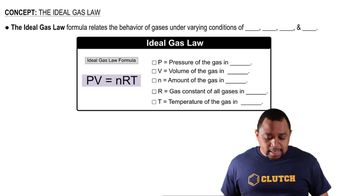
The Ideal Gas Law relates the pressure, volume, temperature, and number of moles of a gas through the equation PV = nRT. This law is fundamental for calculating the behavior of gases under various conditions, allowing us to determine the pressure exerted by a gas in a given volume at a specific temperature.
Recommended video:
Guided course
01:15
Ideal Gas Law Formula

Partial Pressure

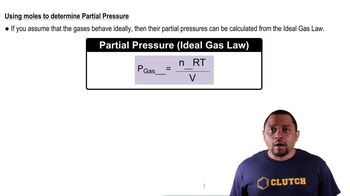
Partial pressure is the pressure that a single gas in a mixture would exert if it occupied the entire volume alone at the same temperature. According to Dalton's Law of Partial Pressures, the total pressure of a gas mixture is the sum of the partial pressures of each individual gas, which is crucial for solving problems involving multiple gases.
Recommended video:
Guided course
00:48
Partial Pressure Calculation

Molar Mass and Moles Calculation

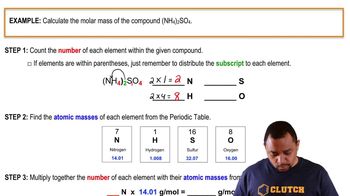
To find the number of moles of a gas, the mass of the gas is divided by its molar mass. This calculation is essential for applying the Ideal Gas Law, as it allows us to convert the mass of the gases present (in grams) into moles, which are needed to determine the partial pressures of each gas in the mixture.
Recommended video:
Guided course
03:12
Molar Mass Calculation Example
Related Practice