
Ch.10 - Gases: Their Properties & Behavior
McMurry - Chemistry 8th Edition
McMurry8th EditionChemistryISBN: 9781292336145Not the one you use?Change textbook
Chapter 10, Problem 145c

An empty 4.00-L steel vessel is filled with 1.00 atm of CH4(g) and 4.00 atm of O2(g) at 300 °C. A spark causes the CH4 to burn completely, according to the equation
CH4(g) + 2 O2(g) → CO2(g) + 2 H2O(g) ΔH° = -802 kJ
(c) What is the partial pressure of CO2(g) in the vessel after combustion?

Verified step by step guidance
1
Identify the balanced chemical equation for the combustion of methane: CH4(g) + 2 O2(g) → CO2(g) + 2 H2O(g). This equation shows that one mole of CH4 reacts with two moles of O2 to produce one mole of CO2 and two moles of H2O.
Determine the initial moles of CH4 and O2 using the ideal gas law, PV = nRT. Given that the pressure (P) of CH4 is 1.00 atm and the volume (V) is 4.00 L, calculate the moles of CH4. Similarly, calculate the moles of O2 using its initial pressure of 4.00 atm.
Use stoichiometry to find the limiting reactant. Compare the mole ratio of CH4 to O2 from the balanced equation with the initial moles calculated. The reactant that produces the least amount of product is the limiting reactant.
Calculate the moles of CO2 produced using the stoichiometry of the reaction. Since the limiting reactant determines the amount of product formed, use the mole ratio from the balanced equation to find the moles of CO2.
Determine the partial pressure of CO2 using the ideal gas law. With the moles of CO2 calculated and the volume and temperature of the vessel known, apply the ideal gas law to find the partial pressure of CO2 in the vessel after combustion.

Verified video answer for a similar problem:

This video solution was recommended by our tutors as helpful for the problem above.
Video duration:
6m
Was this helpful?

Key Concepts

Here are the essential concepts you must grasp in order to answer the question correctly.

Ideal Gas Law

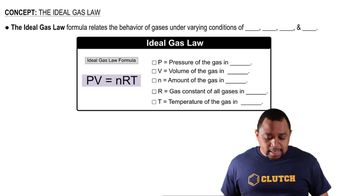
The Ideal Gas Law relates the pressure, volume, temperature, and number of moles of a gas through the equation PV = nRT. This law is essential for understanding how gases behave under different conditions and is crucial for calculating changes in pressure and volume during chemical reactions.
Recommended video:
Guided course
01:15
Ideal Gas Law Formula

Stoichiometry

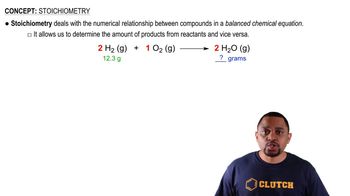
Stoichiometry involves the calculation of reactants and products in chemical reactions based on balanced chemical equations. In this case, it helps determine the amount of CO2 produced from the complete combustion of CH4, allowing for the calculation of its partial pressure after the reaction.
Recommended video:
Guided course
01:16
Stoichiometry Concept

Dalton's Law of Partial Pressures

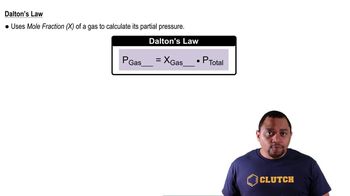
Dalton's Law states that in a mixture of gases, the total pressure is equal to the sum of the partial pressures of each individual gas. This principle is vital for determining the partial pressure of CO2 after the combustion of CH4, as it allows us to account for the contributions of all gases present in the vessel.
Recommended video:
Guided course
00:27
Dalton's Law and Partial Pressure
Related Practice
Textbook Question

An empty 4.00-L steel vessel is filled with 1.00 atm of CH4(g) and 4.00 atm of O2(g) at 300 °C. A spark causes the CH4 to burn completely, according to the equation

CH4(g) + 2 O2(g) → CO2(g) + 2 H2O(g) ΔH° = -802 kJ

(b) What is the final temperature inside the vessel after combustion, assuming that the steel vessel has a mass of 14.500 kg, the mixture of gases has an average molar heat capacity of 21 J/(mol·°C), and the heat capacity of steel is 0.449 J/(g·°C)?

685
views
Textbook Question

A steel container with a volume of 500.0 mL is evacuated, and 25.0 g of CaCO3 is added. The container and contents are then heated to 1500 K, causing the CaCO3 to decompose completely, according to the equation CaCO3(s) → CaO(s) + CO2(g). (b) Now make a more accurate calculation of the pressure inside the container. Take into account the volume of solid CaO (density = 3.34 g/mL) in the container, and use the van der Waals equation to calculate the pressure. The van der Waals constants for CO2(g) are a = 3.59 (L2-atm)/mol2 and b = 0.0427 L/mol.

507
views
Textbook Question

When a gaseous compound X containing only C, H, and O is burned in O2, 1 volume of the unknown gas reacts with 3 volumes of O2 to give 2 volumes of CO2 and 3 volumes of gaseous H2O. Assume all volumes are measured at the same temperature and pressure. (a) Calculate a formula for the unknown gas, and write a balanced equation for the combustion reaction.

793
views
Textbook Question

Isooctane, C8H18, is the component of gasoline from which the term octane rating derives. (a) Write a balanced equation for the combustion of isooctane to yield CO2 and H2O.

518
views