
Textbook Question
What are the basic assumptions of the kinetic–molecular theory?
903
views

 Verified step by step guidance
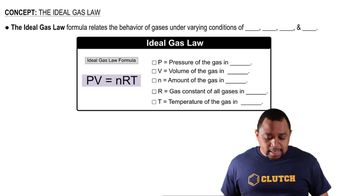
 01:15
01:15
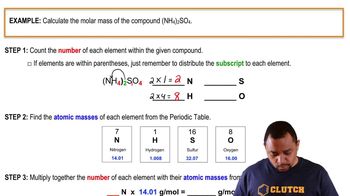 03:12
03:12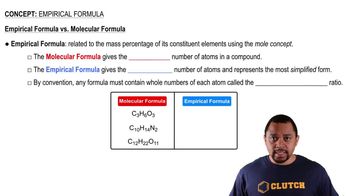 02:26
02:26Natural gas is a mixture of hydrocarbons, primarily methane 1CH42 and ethane 1C2H62. A typical mixture might have Xmethane = 0.915 and Xethane = 0.085. Let's assume that we have a 15.50 g sample of natural gas in a volume of 15.00 L at a temperature of 20.00 °C. (a) How many total moles of gas are in the sample?
What is the difference between heat and temperature?
Natural gas is a mixture of hydrocarbons, primarily methane (CH4) and ethane (C2H6). A typical mixture might have Xmethane = 0.915 and Xethane = 0.085. Let's assume that we have a 15.50 g sample of natural gas in a volume of 15.00 L at a temperature of 20.00 °C. (c) What is the partial pressure of each component in the sample in atmospheres?
Natural gas is a mixture of hydrocarbons, primarily methane (CH4) and ethane (C2H6). A typical mixture might have Xmethane = 0.915 and Xethane = 0.085. Let's assume that we have a 15.50 g sample of natural gas in a volume of 15.00 L at a temperature of 20.00 °C. (b) What is the pressure of the sample in atmospheres?
Gaseous compound Q contains only xenon and oxygen. When 0.100 g of Q is placed in a 50.0-mL steel vessel at 0 °C the pressure is 0.229 atm. (b) When the vessel and its contents are warmed to 100 °C, Q decomposes into its constituent elements. What is the total pressure, and what are the partial pressures of xenon and oxygen in the container?