
Ch.10 - Gases: Their Properties & Behavior
McMurry - Chemistry 8th Edition
McMurry8th EditionChemistryISBN: 9781292336145Not the one you use?Change textbook
Chapter 10, Problem 4

Many laboratory gases are sold in steel cylinders with a volume of 43.8 L. What is the mass in grams of argon inside a cylinder whose pressure is 17,180 kPa at 20 °C? (LO 10.4) (a) 1.83 * 107 g (b) 1.81 * 105 g(c) 1.23 * 104 g (d) 122 g

Verified step by step guidance
1
Identify the ideal gas law equation: \( PV = nRT \), where \( P \) is pressure, \( V \) is volume, \( n \) is the number of moles, \( R \) is the ideal gas constant, and \( T \) is temperature in Kelvin.
Convert the given temperature from Celsius to Kelvin using the formula: \( T(K) = T(°C) + 273.15 \).
Convert the pressure from kPa to atm, since the ideal gas constant \( R \) is typically used in L·atm/(mol·K). Use the conversion: 1 atm = 101.325 kPa.
Rearrange the ideal gas law to solve for \( n \), the number of moles: \( n = \frac{PV}{RT} \). Substitute the values for \( P \), \( V \), \( R \), and \( T \) into the equation.
Calculate the mass of argon by multiplying the number of moles \( n \) by the molar mass of argon (approximately 39.95 g/mol).

Key Concepts

Here are the essential concepts you must grasp in order to answer the question correctly.

Ideal Gas Law

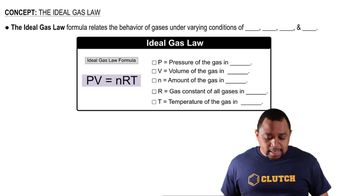
The Ideal Gas Law is a fundamental equation in chemistry that relates the pressure, volume, temperature, and number of moles of a gas. It is expressed as PV = nRT, where P is pressure, V is volume, n is the number of moles, R is the ideal gas constant, and T is temperature in Kelvin. This law allows us to calculate the amount of gas present under specific conditions, which is essential for solving the given problem.
Recommended video:
Guided course
01:15
Ideal Gas Law Formula

Conversion of Units

In chemistry, it is often necessary to convert units to ensure consistency in calculations. For this problem, pressure is given in kilopascals (kPa) and must be converted to atmospheres (atm) or another compatible unit if needed. Additionally, temperature must be converted from Celsius to Kelvin by adding 273.15. Proper unit conversion is crucial for accurate results in gas law calculations.
Recommended video:
Guided course
01:56
Conversion Factors

Molar Mass of Argon

The molar mass of a substance is the mass of one mole of that substance, typically expressed in grams per mole (g/mol). For argon, the molar mass is approximately 39.95 g/mol. Knowing the molar mass is essential for converting the number of moles of argon, calculated from the Ideal Gas Law, into grams, which is the final requirement of the problem.
Recommended video:
Guided course
02:11
Molar Mass Concept