
Pakistan's K2 is the world's second-tallest mountain, with an altitude of 28,251 ft. Its base camp, where climbers stop to acclimate, is located about 16,400 ft above sea level. (a) Approximate atmospheric pressure P at different altitudes is given by the equation P = e-h/7000, where P is in atmospheres and h is the altitude in meters. What is the approximate atmospheric pressure in mm Hg at K2 base camp? (b) What is the atmospheric pressure in mm Hg at the summit of K2?
Ch.10 - Gases: Their Properties & Behavior
Chapter 10, Problem 131
What are the trends in atmospheric CO2 and CH4 concentrations over the past 150 years and over several hundred thousand years?
Verified step by step guidance1
Step 1: Understand the context of the problem by recognizing that atmospheric CO2 (carbon dioxide) and CH4 (methane) are greenhouse gases that have been studied for their impact on climate change.
Step 2: Examine historical data sources for atmospheric CO2 and CH4 concentrations, such as ice core samples, which provide records of gas concentrations over hundreds of thousands of years.
Step 3: Analyze the trend in CO2 concentrations over the past 150 years, noting the significant increase due to industrial activities, fossil fuel combustion, and deforestation.
Step 4: Investigate the trend in CH4 concentrations over the past 150 years, observing the rise due to agricultural practices, waste management, and fossil fuel extraction.
Step 5: Compare these recent trends with data from ice cores that show natural fluctuations in CO2 and CH4 over several hundred thousand years, highlighting the unprecedented rate of increase in recent times.
Key Concepts
Here are the essential concepts you must grasp in order to answer the question correctly.
Greenhouse Gases
Greenhouse gases, such as carbon dioxide (CO2) and methane (CH4), trap heat in the Earth's atmosphere, contributing to the greenhouse effect. Their concentrations are critical in understanding climate change, as increased levels correlate with rising global temperatures. CO2 is primarily released through fossil fuel combustion, while CH4 is emitted from agricultural practices and landfills.
Recommended video:
Guided course
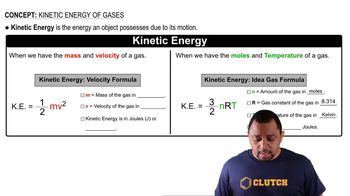
Kinetic Energy Formulas
Historical Climate Data
Historical climate data, derived from ice cores, tree rings, and sediment layers, provide insights into atmospheric gas concentrations over time. Ice cores, for instance, trap air bubbles that preserve ancient atmospheric conditions, allowing scientists to analyze CO2 and CH4 levels over hundreds of thousands of years. This data reveals natural fluctuations and the impact of human activities on current trends.
Recommended video:
Guided course
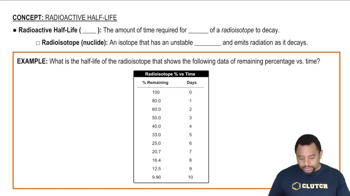
Intro to Radioactive Half-Life
Trends in Atmospheric Concentrations
Trends in atmospheric concentrations of CO2 and CH4 over the past 150 years show a significant increase, particularly since the Industrial Revolution. CO2 levels have risen from about 280 ppm to over 400 ppm, while CH4 concentrations have more than doubled. Understanding these trends is essential for assessing the anthropogenic impact on climate and predicting future changes.
Recommended video:
Guided course
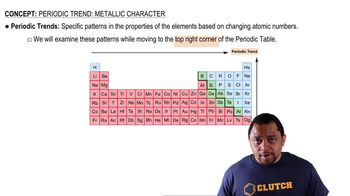
Periodic Trends
Related Practice
Textbook Question
832
views
Textbook Question
Pakistan's K2 is the world's second-tallest mountain, with an altitude of 28,251 ft. Its base camp, where climbers stop to acclimate, is located about 16,400 ft above sea level. (c) Assuming the mole fraction of oxygen in air is 0.2095, what is the partial pressure of oxygen in mm Hg at the summit of K2?
520
views
Textbook Question
A driver with a nearly empty fuel tank may say she is 'running on fumes.' If a 15.0-gallon automobile gas tank had only gasoline vapor remaining in it, what is the farthest the vehicle could travel if it gets 20.0 miles per gallon on liquid gasoline? Assume the average molar mass of molecules in gasoline is 105 g/mol, the density of liquid gasoline is 0.75 g/mL, the pressure is 743 mm Hg, and the temperature is 25 °C.
633
views
Textbook Question
The percent by volume of oxygen (20.95%) is constant throughout the troposphere. (a) Express this percentage as a mole fraction.
1867
views
