
Ch.11 - Liquids & Phase Changes
McMurry - Chemistry 8th Edition
McMurry8th EditionChemistryISBN: 9781292336145Not the one you use?Change textbook
Chapter 11, Problem 49

How much energy in kilojoules is released when 25.0 g of ethanol vapor at 93.0 °C is cooled to -11.0 °C? Ethanol has mp = -114.1 °C, bp = 78.3 °C, ΔHvap = 38.56 kJ>mol, and ΔHfusio#n = 4.93 kJ>mol. The molar heat#capacity is 112.3 J>1K mol2 for the liquid and 65.6 J>1K vapor.

Verified step by step guidance
1
Calculate the number of moles of ethanol using its molar mass. The molar mass of ethanol (C2H5OH) is approximately 46.07 g/mol.
Since the initial temperature of ethanol vapor is 93.0 °C and it needs to be cooled to -11.0 °C, first calculate the energy released when ethanol vapor is cooled from 93.0 °C to its boiling point, 78.3 °C, using the molar heat capacity of the vapor.
Calculate the energy released during the condensation of ethanol vapor at its boiling point using the given heat of vaporization (ΔHvap).
After condensation, calculate the energy released when the liquid ethanol is further cooled from 78.3 °C to -11.0 °C using the molar heat capacity of the liquid.
Sum up all the energy values obtained in the previous steps to find the total energy released during the entire cooling process.

Key Concepts

Here are the essential concepts you must grasp in order to answer the question correctly.

Phase Changes

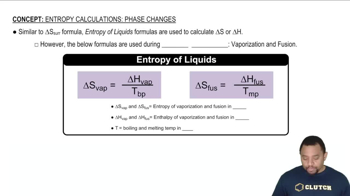
Phase changes refer to the transitions between solid, liquid, and gas states of matter, which occur at specific temperatures and pressures. In this question, ethanol transitions from vapor to liquid and then to solid as it cools. Understanding the enthalpy changes associated with these phase transitions, such as the heat of vaporization (ΔHvap) and heat of fusion (ΔHfusion), is crucial for calculating the total energy change.
Recommended video:
Guided course
01:46
Entropy in Phase Changes

Specific Heat Capacity

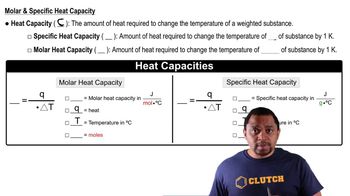
Specific heat capacity is the amount of heat required to raise the temperature of a unit mass of a substance by one degree Celsius (or Kelvin). In this problem, the specific heat capacities for both the vapor and liquid phases of ethanol are provided, which are essential for calculating the energy change during the temperature change of ethanol vapor as it cools down to its melting point.
Recommended video:
Guided course
02:19
Heat Capacity

Energy Calculations in Thermodynamics

Energy calculations in thermodynamics involve using formulas to quantify heat transfer during physical and chemical processes. In this scenario, the total energy released when cooling ethanol includes contributions from cooling the vapor, condensing it to liquid, cooling the liquid, freezing it to solid, and finally cooling the solid. Each step requires applying the appropriate heat equations, considering mass, specific heat, and enthalpy changes.
Recommended video:
Guided course
01:18
First Law of Thermodynamics
Related Practice
Textbook Question
Water at room temperature is placed in a flask connected by rubber tubing to a vacuum pump, and the pump is turned on. After several minutes, the volume of the water has decreased, and what remains has turned to ice. Explain
367
views
Textbook Question
How much energy in kilojoules is needed to heat 5.00 g of ice from -11.0 °C to °30.0 °C? The heat of fusion of water is 6.01 kJ>mol, and the m# olar heat capacity is 36.01 kJ>mol for ice and 75.4 J/K mol2 for liquid water
1016
views
Textbook Question
Benzene has a melting point of 5.53 °C and a boiling point of 80.09 °C at atmospheric pressure. Its density is0.8787 g>cm3 when liquid and 0.899 g>cm3 when solid; it has Tc = 289.01 °C, Pc = 48.34 atm, Tt = 5.52 °C, and Pt = 0.0473 atm. Starting from a point at 200 K and66.5 atm, trace the following path on a phase diagram. (1) First, increase T to 585 K while keeping P constant.(2) Next, decrease P to 38.5 atm while keeping T constant.(3) Then, decrease T to 278.66 K while keeping P constant.(4) Finally, decrease P to 0.0025 atm while keeping Tconstant.What is your starting phase, and what is your final phase?
2486
views
Textbook Question

Naphthalene, better known as 'mothballs,' has bp = 218 °C and ΔHvap = 43.3 kJ>mol. What is the entropy of vaporization, ΔSvap in J/(K mol) for naphthalene?

735
views
Textbook Question
Mercury has mp = -38.8 °C and bp = 356.6 °C. What,if any, phase changes take place under the following condi-tions at 1.0 atm pressure? (a) The temperature of a sample is raised from -30 °C to 365 °C.
821
views