
Ch.13 - Solutions & Their Properties
McMurry - Chemistry 8th Edition
McMurry8th EditionChemistryISBN: 9781292336145Not the one you use?Change textbook
Chapter 13, Problem 144

Elemental analysis of b@carotene, a dietary source of vitamin A, shows that it contains 10.51% H and 89.49% C. Dissolving 0.0250 g of b@carotene in 1.50 g of camphor gives a freezing- point depression of 1.17 °C. What are the molecular weight and formula of b@carotene? [Kf for camphor is 37.7 1°C kg2>mol.]

Verified step by step guidance
1
First, let's determine the empirical formula of b@carotene. The empirical formula is the simplest whole number ratio of atoms in a compound. Given the percentages of hydrogen (H) and carbon (C), we can assume a 100g sample. This means we have 10.51g of H and 89.49g of C. Convert these masses to moles by dividing by the atomic masses of H (1.01 g/mol) and C (12.01 g/mol).
Next, divide the number of moles of each element by the smallest number of moles calculated in the previous step. This will give you the ratio of atoms in the empirical formula.
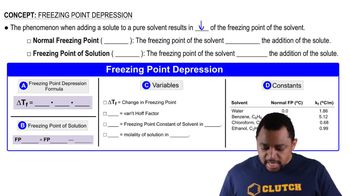
Now, let's find the molecular weight of b@carotene. We can use the freezing point depression of the solution and the formula ΔTf = Kf * m, where ΔTf is the freezing point depression, Kf is the cryoscopic constant, and m is the molality of the solution. The molality can be calculated as moles of solute divided by kilograms of solvent.
Using the molality and the mass of b@carotene, we can calculate the moles of b@carotene. Then, divide the mass of b@carotene by the moles to get the molecular weight.
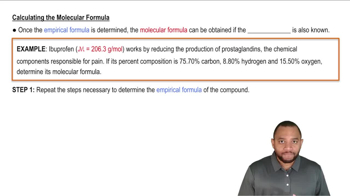
Finally, divide the molecular weight by the empirical formula weight (which can be calculated from the empirical formula obtained in step 2). If this number is close to a whole number, multiply the subscripts in the empirical formula by this number to get the molecular formula of b@carotene.

Verified video answer for a similar problem:

This video solution was recommended by our tutors as helpful for the problem above.
Video duration:
9m
Was this helpful?

Key Concepts

Here are the essential concepts you must grasp in order to answer the question correctly.

Freezing Point Depression

Freezing point depression is a colligative property that describes the lowering of a solvent's freezing point when a solute is added. The extent of this depression is directly proportional to the number of solute particles in the solution. The formula used to calculate freezing point depression is ΔTf = Kf * m, where ΔTf is the change in freezing point, Kf is the freezing point depression constant of the solvent, and m is the molality of the solution.
Recommended video:
Guided course
01:59
Freezing Point Depression

Molecular Weight Calculation

Molecular weight, or molar mass, is the mass of one mole of a substance, typically expressed in grams per mole (g/mol). To determine the molecular weight of a compound, one must first find the number of moles of solute using the freezing point depression data and the known Kf value. Once the moles are calculated, the molecular weight can be found by dividing the mass of the solute by the number of moles.
Recommended video:
Guided course
6:53
Molecular Formula Calculation Example

Empirical and Molecular Formulas

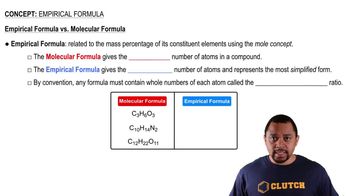
The empirical formula represents the simplest whole-number ratio of elements in a compound, while the molecular formula indicates the actual number of atoms of each element in a molecule. To derive the molecular formula from the empirical formula, one must determine the molar mass of the compound and compare it to the molar mass of the empirical formula. This comparison helps in identifying the factor by which the empirical formula must be multiplied to obtain the molecular formula.
Recommended video:
Guided course
02:26
Empirical vs Molecular Formula
Related Practice
Textbook Question
Addition of 50.00 mL of 2.238 m H2SO4 1solution density= 1.1243 g>mL2 to 50.00 mL of 2.238 M BaCl2 gives a white precipitate.(b) If you filter the mixture and add more H2SO4 solution to the filtrate, would you obtain more precipitate? Explain.
368
views
Textbook Question
A solution of LiCl in a mixture of water and methanol 1CH3OH2 has a vapor pressure of 39.4 mm Hg at 17 °C and 68.2 mm Hg at 27 °C. The vapor pressure of pure water is 14.5 mm Hg at 17 °C and 26.8 mm Hg at 27 °C, and the vapor pressure of pure methanol is 82.5 mm Hg at 17 °C and 140.3 mm Hg at 27 °C. What is the composition of the solution in mass percent?
715
views
Textbook Question
Desert countries like Saudi Arabia have built reverse osmo-sis plants to produce freshwater from seawater. Assume that seawater has the composition 0.470 M NaCl and 0.068 M MgCl2 and that both compounds are completelydissociated.(b) If the reverse osmosis equipment can exert a maximum pressure of 100.0 atm at 25.0 °C, what is the maximum volume of freshwater that can be obtained from 1.00 L of seawater?
368
views
Textbook Question
At 60 °C, compound X has a vapor pressure of 96 mm Hg, benzene 1C6H62 has a vapor pressure of 395 mm Hg, and a 50:50 mixture by mass of benzene and X has a vapor pres- sure of 299 mm Hg. What is the molar mass of X?
343
views
Textbook Question

Treatment of 1.385 g of an unknown metal M with an excess of aqueous HCl evolved a gas that was found to have a volume of 382.6 mL at 20.0 °C and 755 mm Hg pressure. Heating the reaction mixture to evaporate the water and remaining HCl then gave a white crystalline compound, MClx. After dissolving the compound in 25.0 g of water, the melting point of the resulting solution was - 3.53 °C. (b) What mass of MClx is formed? (a) How many moles of H2 gas are evolved?

1
views