Ethanol 1CH CH OH 2 dissolves in hexane 1C H 2. Give the strongest type of intermolecular force between two sol- ute molecules, between two solvent molecules, and between a solute and solvent molecule. (LO 13.1) (a)
Verified step by step guidance
1
Identify the types of molecules involved: Ethanol (CH3CH2OH) as the solute and hexane (C6H14) as the solvent.
Determine the strongest intermolecular force between two ethanol molecules. Ethanol can form hydrogen bonds due to the presence of an -OH group.
Determine the strongest intermolecular force between two hexane molecules. Hexane is a nonpolar molecule, so the strongest intermolecular force is dispersion forces.
Determine the strongest intermolecular force between an ethanol molecule and a hexane molecule. Since ethanol is polar and hexane is nonpolar, the strongest intermolecular force is likely to be dispersion forces.
Match the identified intermolecular forces with the options provided in the table to find the correct combination.
Verified video answer for a similar problem:
This video solution was recommended by our tutors as helpful for the problem above.
Video duration:
7m
Play a video:
0 Comments
Was this helpful?
Key Concepts
Here are the essential concepts you must grasp in order to answer the question correctly.
Intermolecular Forces
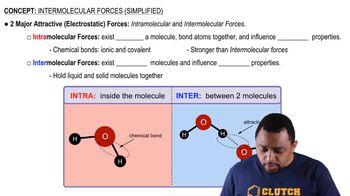
Intermolecular forces are the attractive forces between molecules that influence physical properties such as boiling and melting points. The main types include hydrogen bonding, dipole-dipole interactions, and dispersion forces. Understanding these forces is crucial for predicting how substances interact, especially in solutions.
Hydrogen bonding is a strong type of dipole-dipole interaction that occurs when hydrogen is bonded to highly electronegative atoms like oxygen, nitrogen, or fluorine. This interaction significantly affects the properties of substances, such as the solubility of ethanol in water, and is a key factor in the behavior of solute and solvent molecules.
Solubility and Miscibility
Solubility refers to the ability of a solute to dissolve in a solvent, while miscibility describes the ability of two liquids to mix in all proportions. The nature of intermolecular forces between solute and solvent molecules determines their solubility. For example, polar solvents like water can dissolve polar solutes like ethanol due to hydrogen bonding.



 Verified step by step guidance
 01:59
01:59