Ch.14 - Chemical Kinetics
McMurry - Chemistry 8th Edition
McMurry8th EditionChemistryISBN: 9781292336145Not the one you use?Change textbook
Chapter 14, Problem 41b

Consider the first-order decomposition of A molecules (red spheres) in three vessels of equal volume. (1)-(3)
(b) What are the relative half-lives of the reactions in vessels (1)–(3)?

Verified step by step guidance
1
Step 1: Understand the concept of half-life. The half-life of a reaction is the time it takes for the concentration of the reactant to decrease to half of its initial value. For a first-order reaction, the half-life is independent of the initial concentration of the reactant.
Step 2: Apply the concept to the problem. Since the decomposition of A is a first-order reaction, the half-lives of the reactions in all three vessels are the same, regardless of the initial concentration of A in each vessel.
Step 3: Therefore, the relative half-lives of the reactions in vessels (1)-(3) are equal. This is because the half-life of a first-order reaction is determined only by the rate constant, not the initial concentration.
Step 4: Remember that the rate constant is a characteristic of the particular reaction at a given temperature, and does not change with the concentration of the reactant.
Step 5: In conclusion, for first-order reactions, the half-life is constant and does not depend on the initial concentration of the reactant. Therefore, the relative half-lives of the reactions in vessels (1)-(3) are equal.

Verified video answer for a similar problem:

This video solution was recommended by our tutors as helpful for the problem above.
Video duration:
1m
Was this helpful?

Key Concepts

Here are the essential concepts you must grasp in order to answer the question correctly.

First-Order Reactions

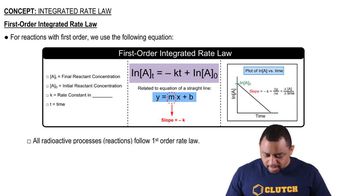
First-order reactions are chemical reactions where the rate is directly proportional to the concentration of one reactant. This means that as the concentration of the reactant decreases, the rate of reaction also decreases. The mathematical representation of a first-order reaction is given by the equation: rate = k[A], where k is the rate constant and [A] is the concentration of reactant A.
Recommended video:
Guided course
02:29
First-Order Reactions

Half-Life

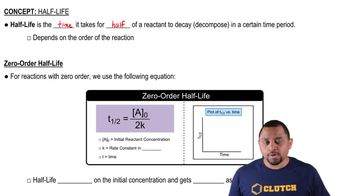
The half-life of a reaction is the time required for the concentration of a reactant to decrease to half of its initial value. For first-order reactions, the half-life is constant and does not depend on the initial concentration of the reactant. The half-life can be calculated using the formula: t1/2 = 0.693/k, where k is the rate constant.
Recommended video:
Guided course
02:17
Zero-Order Half-life

Reaction Conditions and Rate Constants

The rate constant (k) for a reaction can vary based on factors such as temperature, pressure, and the presence of catalysts. In the context of the question, if the vessels (1)-(3) have different conditions (e.g., temperature), the rate constants will differ, leading to variations in half-lives. Understanding how these conditions affect k is crucial for determining the relative half-lives of the reactions in the different vessels.
Recommended video:
Guided course
00:45
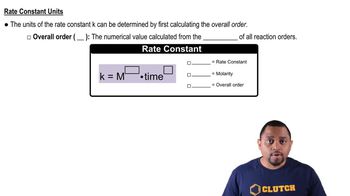
Rate Constant Units