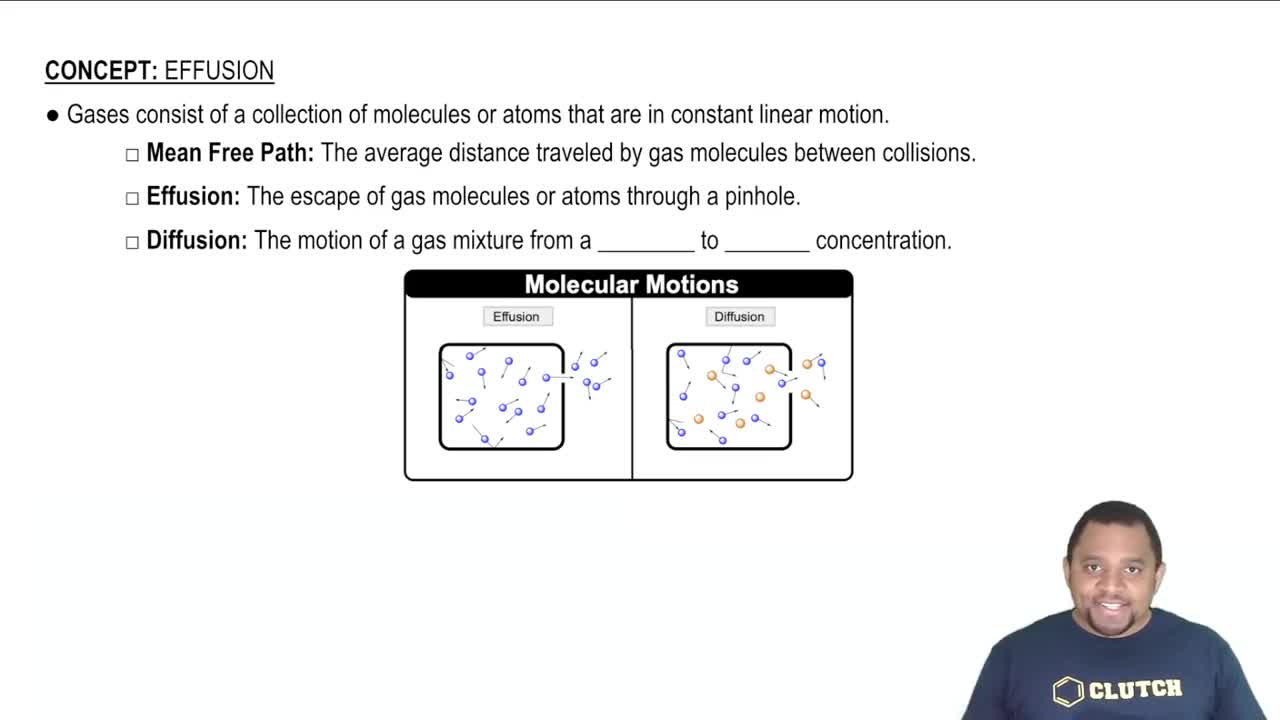
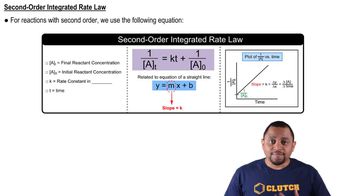
Some reactions are so rapid that they are said to be diffusion-controlled; that is, the reactants react as quickly as they can collide. An example is the neutralization of H3O+ by OH-, which has a second-order rate constant of 1.3⨉1011 M-1 s-1 at 25 °C. (a) If equal volumes of 2.0 M HCl and 2.0 M NaOH are mixed instantaneously, how much time is required for 99.999% of the acid to be neutralized?
Verified step by step guidanceKey Concepts
Diffusion-Controlled Reactions
Second-Order Kinetics
Rate Constant and Reaction Time
Consider the reversible, first-order interconversion of two molecules A and B: where kf = 3.0⨉10-3 s-1 is the rate constant for the forward reaction and kr = 1.0⨉10-3 s-1 is the rate constant for the reverse reaction. We'll see in Chapter 15 that a reaction does not go to completion but instead reaches a state of equilibrium with comparable concentrations of reactants and products if the rate constants kf and kr have comparable values.
(c) What are the relative concentrations of B and A when the rates of the forward and reverse reactions become equal?

Some reactions are so rapid that they are said to be diffusion-controlled; that is, the reactants react as quickly as they can collide. An example is the neutralization of H3O+ by OH-, which has a second-order rate constant of 1.3⨉1011 M-1 s-1 at 25 °C. (b) Under normal laboratory conditions, would you expect the rate of the acid–base neutralization to be limited by the rate of the reaction or by the speed of mixing?