Ch.14 - Chemical Kinetics
McMurry - Chemistry 8th Edition
McMurry8th EditionChemistryISBN: 9781292336145Not the one you use?Change textbook
Chapter 14, Problem 89

What fraction of the molecules in a gas at 300 K collide with an energy equal to or greater than Ea when Ea equals 50 kJ/mol? What is the value of this fraction when Ea is 100 kJ/mol?

Verified step by step guidance
1
insert step 1> Convert the activation energy (Ea) from kJ/mol to J/mol by multiplying by 1000, since 1 kJ = 1000 J.
insert step 2> Use the Arrhenius equation to find the fraction of molecules with energy equal to or greater than Ea: \( f = e^{-\frac{E_a}{RT}} \), where R is the gas constant (8.314 J/mol·K) and T is the temperature in Kelvin.
insert step 3> Substitute the values for Ea (in J/mol), R, and T (300 K) into the equation for both cases: Ea = 50,000 J/mol and Ea = 100,000 J/mol.
insert step 4> Calculate the exponent \( -\frac{E_a}{RT} \) for each case to find the fraction of molecules.
insert step 5> Interpret the results to understand how the fraction of molecules changes with different activation energies.

Verified video answer for a similar problem:

This video solution was recommended by our tutors as helpful for the problem above.
Video duration:
2m
Was this helpful?

Key Concepts

Here are the essential concepts you must grasp in order to answer the question correctly.

Kinetic Molecular Theory

Kinetic Molecular Theory explains the behavior of gases in terms of particles in constant motion. It posits that gas molecules move randomly and collide with each other and the walls of their container. The average kinetic energy of these molecules is directly proportional to the temperature of the gas, which is crucial for understanding how temperature affects collision energy.
Recommended video:
Guided course
01:19
Kinetic Molecular Theory

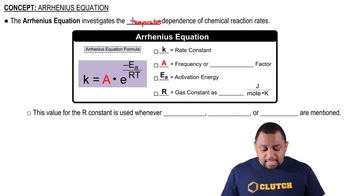
Arrhenius Equation

The Arrhenius Equation relates the rate of a chemical reaction to temperature and activation energy (Ea). It shows that the fraction of molecules with energy equal to or greater than Ea increases with temperature. This equation is essential for calculating the fraction of gas molecules that can overcome the activation energy barrier during collisions.
Recommended video:
Guided course
01:20
Arrhenius Equation

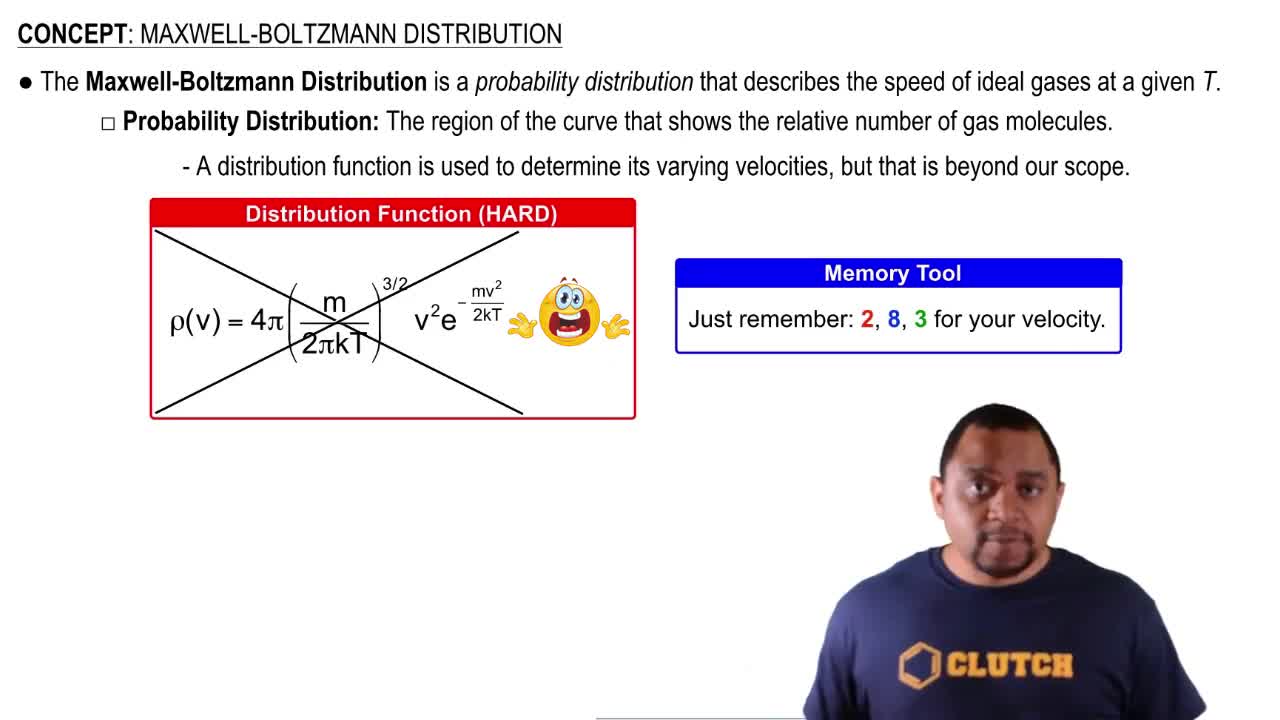
Maxwell-Boltzmann Distribution

The Maxwell-Boltzmann Distribution describes the distribution of speeds (and thus kinetic energies) of particles in a gas. It indicates that at a given temperature, only a fraction of molecules have sufficient energy to overcome the activation energy barrier. This concept is key to determining the fraction of molecules that can successfully collide with energy equal to or greater than Ea.
Recommended video:
Guided course
00:54
Maxwell-Boltzmann Distribution
Related Practice
Textbook Question
Why don't all collisions between reactant molecules lead to a chemical reaction?
637
views

Textbook Question

Consider three reactions with different values of Ea and ΔE:

Reaction 1. Ea = 20 kJ>mol; ΔE = -60 kJ/mol

Reaction 2. Ea = 10 kJ>mol; ΔE = -20 kJ/mol

Reaction 3. Ea = 40 kJ>mol; ΔE = +15 kJ/mol

(c) Which reaction is the most endothermic, and which is the most exothermic?

466
views
Textbook Question
Trans-cycloheptene 1C7H122, a strained cyclic hydrocarbon, converts to cis-cycloheptene at low temperatures. This molecular rearrangement is a second-order process with a rate constant of 0.030 M-1 s-1 at 60 °C. If the initial concentration of trans-cycloheptene is 0.035 M: (c) What is the half-life of trans-cycloheptene at an initial concentration of 0.075 M?
349
views
Textbook Question

Consider three reactions with different values of Ea and ΔE:

Reaction 1. Ea = 20 kJ>mol; ΔE = -60 kJ/mol

Reaction 2. Ea = 10 kJ>mol; ΔE = -20 kJ/mol

Reaction 3. Ea = 40 kJ>mol; ΔE = +15 kJ/mol

(b) Assuming that all three reactions are carried out at the same temperature and that all three have the same frequency factor A, which reaction is the fastest and which is the slowest?

514
views
Textbook Question
Two reactions have the same activation energy, but their rates at the same temperature differ by a factor of 10. Explain.
751
views
Textbook Question
A certain first-order reaction has a rate constant of 1.0 * 10-3 s-1 at 25 °C. (b) What is the Ea (in kJ/mol) if the same temperature change causes the rate to triple?
1393
views
1
rank