
Ch.15 - Chemical Equilibrium
McMurry - Chemistry 8th Edition
McMurry8th EditionChemistryISBN: 9781292336145Not the one you use?Change textbook
Chapter 15, Problem 159b

Consider the sublimation of mothballs at 27 °C in a room having dimensions 8.0 ft ⨉ 10.0 ft ⨉ 8.0 ft. Assume that the mothballs are pure solid naphthalene (density 1.16 g/cm3) and that they are spheres with a diameter of 12.0 mm. The equilibrium constant Kc for the sublimation of naphthalene is 5.40⨉10-6 at 27 °C. C10H8(s) ⇌ C10H8(g) (b) How many mothballs are required to saturate the room with gaseous naphthalene?

Verified step by step guidance
1
Calculate the volume of the room in cubic meters by converting the dimensions from feet to meters and then multiplying them together.
Determine the volume of a single mothball by using the formula for the volume of a sphere, \( V = \frac{4}{3} \pi r^3 \), where \( r \) is the radius in meters.
Calculate the mass of a single mothball using its volume and the given density of naphthalene, \( \text{mass} = \text{density} \times \text{volume} \).
Use the equilibrium constant \( K_c \) to find the concentration of gaseous naphthalene at equilibrium, which is equal to \( K_c \) since the reaction involves the sublimation of a solid to a gas.
Determine the number of moles of gaseous naphthalene needed to saturate the room by multiplying the concentration by the volume of the room, and then calculate the number of mothballs required by dividing the total moles by the moles per mothball.

Key Concepts

Here are the essential concepts you must grasp in order to answer the question correctly.

Sublimation

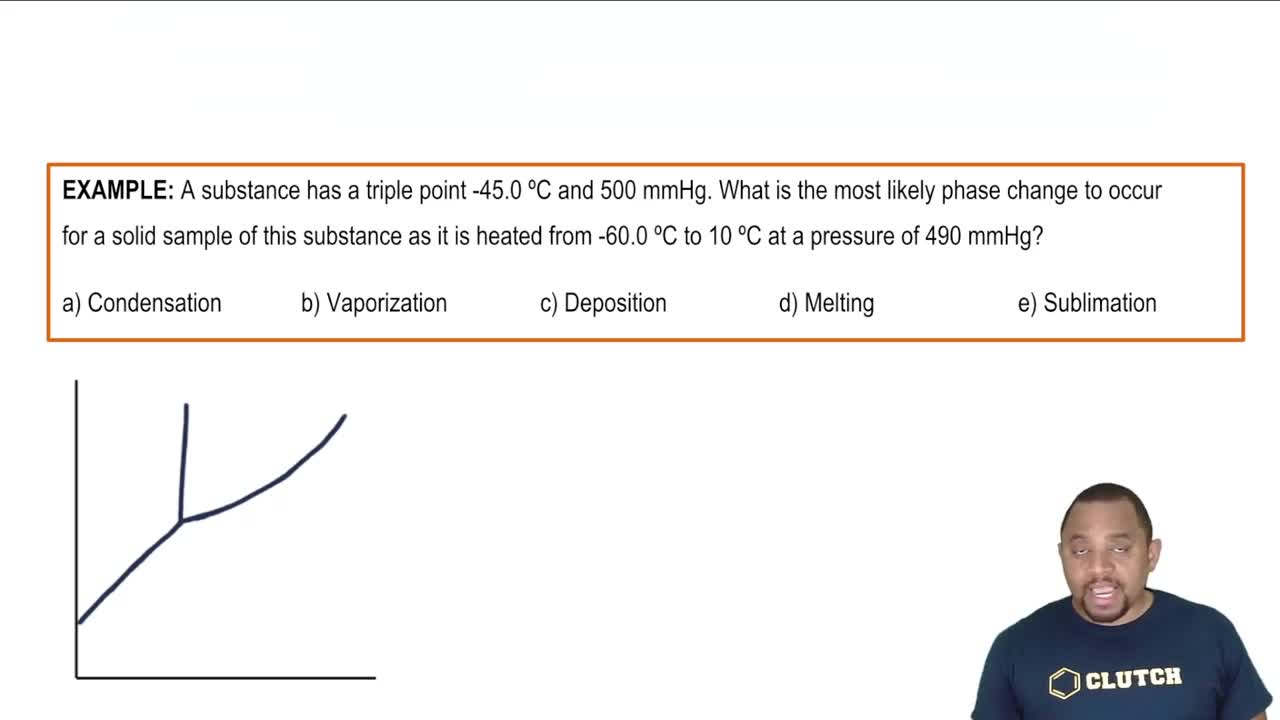
Sublimation is the process in which a solid transitions directly into a gas without passing through the liquid phase. In the context of naphthalene, this means that solid mothballs can vaporize into gaseous naphthalene at a given temperature, contributing to the equilibrium between solid and gas phases. Understanding sublimation is crucial for calculating how much solid is needed to reach a certain concentration of gas in a defined volume.
Recommended video:
Guided course
01:52
Sublimation Phase Change Example

Equilibrium Constant (Kc)

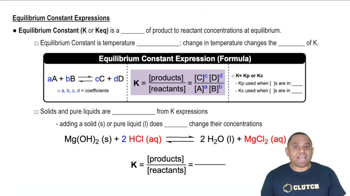
The equilibrium constant (Kc) quantifies the ratio of the concentrations of products to reactants at equilibrium for a reversible reaction. For the sublimation of naphthalene, Kc indicates the extent to which naphthalene will vaporize at 27 °C. A low Kc value, such as 5.40×10^-6, suggests that at equilibrium, the concentration of gaseous naphthalene will be much lower than that of the solid, which is essential for determining how many mothballs are needed to saturate the room.
Recommended video:
Guided course
03:20
Equilibrium Constant Expressions

Volume and Density Calculations

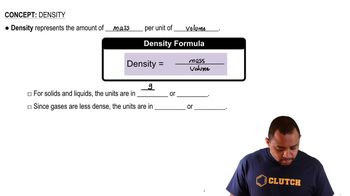
To determine how many mothballs are needed to saturate the room, one must calculate the volume of the room and the volume occupied by the mothballs. The density of naphthalene allows for the conversion between mass and volume, which is necessary for finding the total mass of naphthalene required to achieve saturation. This involves using the room's dimensions and the physical properties of naphthalene to derive the number of mothballs needed.
Recommended video:
Guided course
01:56
Density Concepts