Ch.15 - Chemical Equilibrium
McMurry - Chemistry 8th Edition
McMurry8th EditionChemistryISBN: 9781292336145Not the one you use?Change textbook
Chapter 15, Problem 15.62c

The reaction 2 AsH31g2 ∆ As21g2 + 3 H21g2 has Kp =
7.2 * 107 at 1073 K. At the same temperature, what is Kp
for each of the following reactions?
(c) 9 H21g2 + 3 As21g2 ∆ 6 AsH31g2

Verified step by step guidance
1
Identify the relationship between the given reaction and the target reaction. The target reaction can be derived by reversing the given reaction and then multiplying it by 3.
Write the expression for the equilibrium constant (Kp) for the given reaction: Kp = [As2]^2 * [H2]^3 / [AsH3]^2.
For the reversed reaction, the equilibrium constant expression will be the reciprocal of the original reaction's Kp. Thus, Kp' = 1 / Kp.
Since the target reaction is 3 times the reversed reaction, raise the Kp' to the power of 3 to find the new Kp for the target reaction: Kp'' = (Kp')^3.
Substitute the value of Kp from the given reaction into the expression derived in step 4 to find the Kp for the target reaction.

Verified video answer for a similar problem:

This video solution was recommended by our tutors as helpful for the problem above.
Video duration:
4m
Was this helpful?

Key Concepts

Here are the essential concepts you must grasp in order to answer the question correctly.

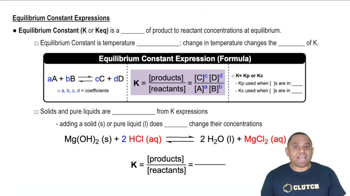
Equilibrium Constant (Kp)

The equilibrium constant, Kp, is a numerical value that expresses the ratio of the partial pressures of the products to the reactants at equilibrium for a given reaction at a specific temperature. It is derived from the balanced chemical equation and indicates the extent to which a reaction favors products or reactants. A larger Kp value suggests a greater concentration of products at equilibrium.
Recommended video:
Guided course
03:20
Equilibrium Constant Expressions

Reaction Stoichiometry

Reaction stoichiometry refers to the quantitative relationship between the reactants and products in a chemical reaction, as represented by the coefficients in a balanced equation. This concept is crucial for determining how changes in the amounts of reactants or products affect the equilibrium position and the calculation of equilibrium constants for related reactions.
Recommended video:
Guided course
01:16
Stoichiometry Concept

Reverse Reaction and Kp Relationship

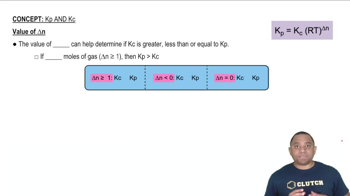
The equilibrium constant for a reverse reaction is the reciprocal of the equilibrium constant for the forward reaction. If a reaction is reversed, the Kp value must be inverted to reflect the new direction of the reaction. This relationship is essential for calculating Kp for different but related reactions, as seen in the provided question.
Recommended video:
Guided course
02:18
Kp vs Kc Relationship
Related Practice
Textbook Question

If Kc = 7.5×10⁻⁹ at 1000 K for the reaction N2(g) + O2(g) → 2 NO(g), give the value of Kc at 1000 K for the reaction

(a) 2 NO(g) → N2(g) + O2(g)

115
views

Textbook Question
The reaction A2 + B ∆ A + AB has an equilibrium con-stant Kc = 2. The following pictures represent reaction mix- tures that contain A atoms (red), B atoms (blue), and A2 and AB molecules.

(a) Which reaction mixture is at equilibrium?
530
views
Textbook Question

If Kc = 7.5×10⁻⁹ at 1000 K for the reaction N2(g) + O2(g) → 2 NO(g), give the value of Kc at 1000 K for the reaction

(b) NO(g) → 1/2 N2(g) + 1/2 O2(g)

89
views
Textbook Question
Consider the interconversion of A molecules (red spheres) and B molecules (blue spheres) according to the reaction A ∆ B. Each of the series of pictures at the right represents a separate experiment in which time increases from left to right:(b) What is the value of the equilibrium constant Kc for the reaction A ∆ B?

577
views
Textbook Question
Consider the reaction A + B ∆ AB. The vessel on the right contains an equilibrium mixture of A molecules (red spheres), B molecules (blue spheres), and AB molecules. If the stopcock is opened and the contents of the two vessels are allowed to mix, will the reaction go in the forward or reverse direction? Explain.

554
views
Textbook Question

The reaction 2 AsH31g2 ∆ As21g2 + 3 H21g2 has Kp =

7.2 * 107 at 1073 K. At the same temperature, what is Kp

for each of the following reactions?

(b) 4 AsH31g2 ∆ 2 As21g2 + 6 H21g2

102
views