
Ch.15 - Chemical Equilibrium
McMurry - Chemistry 8th Edition
McMurry8th EditionChemistryISBN: 9781292336145Not the one you use?Change textbook
Chapter 15, Problem 137

Which of the following relative values of kf and kr results in an equilibrium mixture that contains large amounts of reactants and small amounts of products? (a) kf 7 kr (b) kf = kr (c) kf 6 kr

Verified step by step guidance
1
Identify the meaning of kf and kr: kf represents the forward reaction rate constant, and kr represents the reverse reaction rate constant.
Understand the relationship between kf, kr, and the position of equilibrium: If kf > kr, the reaction favors the formation of products. If kf < kr, the reaction favors the formation of reactants.
Analyze the given options to determine which scenario leads to a reaction favoring the formation of reactants: (a) kf > kr, (b) kf = kr, (c) kf < kr.
Compare the options to the desired condition of having large amounts of reactants and small amounts of products, which indicates that the equilibrium should lie towards the reactants.
Conclude that the correct option where kf < kr (option c) will result in an equilibrium mixture containing large amounts of reactants and small amounts of products.

Verified video answer for a similar problem:

This video solution was recommended by our tutors as helpful for the problem above.
Video duration:
1m
Was this helpful?

Key Concepts

Here are the essential concepts you must grasp in order to answer the question correctly.

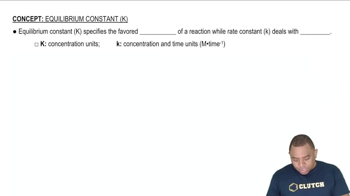
Equilibrium Constant (K)

The equilibrium constant (K) is a numerical value that expresses the ratio of the concentrations of products to reactants at equilibrium for a given reaction at a specific temperature. It is defined as K = [products]^[coefficients] / [reactants]^[coefficients]. A large K value indicates that products are favored at equilibrium, while a small K value suggests that reactants are favored.
Recommended video:
Guided course
01:14
Equilibrium Constant K

Forward and Reverse Rate Constants (kf and kr)

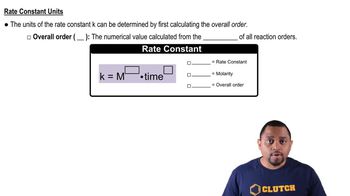
The forward rate constant (kf) and the reverse rate constant (kr) are parameters that describe the speed of the forward and reverse reactions, respectively. The relationship between these constants determines the position of equilibrium. If kf is much smaller than kr, the reaction favors the formation of reactants, leading to a higher concentration of reactants at equilibrium.
Recommended video:
Guided course
00:45
Rate Constant Units

Le Chatelier's Principle

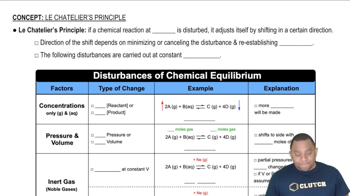
Le Chatelier's Principle states that if a system at equilibrium is subjected to a change in concentration, temperature, or pressure, the system will adjust to counteract that change and restore a new equilibrium. This principle helps predict how changes in conditions will affect the concentrations of reactants and products, providing insight into the behavior of the equilibrium mixture.
Recommended video:
Guided course
07:32
Le Chatelier's Principle
Related Practice
Textbook Question
In automobile catalytic converters, the air pollutant nitric oxide is converted to nitrogen and oxygen. Listed in the table are forward and reverse rate constants for the reac- tion 2 NO1g2 ∆ N21g2 + O21g2. Temperature (K) kf1M — 1 s-12 kr1M-1 s — 121400 0.29 1.1 * 10-61500 1.3 1.4 * 10-5Is the reaction endothermic or exothermic? Explain in terms of kinetics.
429
views
Textbook Question
Consider a general, single-step reaction of the type A + B ∆ C. Show that the equilibrium constant is equal to the ratio of the rate constants for the forward and reverse reactions, Kc = kf>kr.
537
views
Textbook Question
Given the Arrhenius equation, k = Ae-Ea>RT, and the rela- tion between the equilibrium constant and the forward and reverse rate constants, Kc = kf>kr, explain why Kc for an exothermic reaction decreases with increasing temperature.
407
views
Textbook Question
Consider the reaction of chloromethane with OH- in aque- ous solution: CH Cl1aq2 + OH-1aq2 ∆kf CH OH1aq2 + Cl-1aq2 At 25 °C, the rate constant for the forward reaction is 6 * 10-6 M-1 s-1, and the equilibrium constant Kc is 1 * 1016. Calculate the rate constant for the reverse reac- tion at 25 °C.
380
views
Textbook Question
A platinum catalyst is used in automobile catalytic convert- ers to hasten the oxidation of carbon monoxide:2 CO1g2 + O 1g2 ∆Pt 2 CO 1g2 ΔH° = - 566 kJSuppose that you have a reaction vessel containing an equilibrium mixture of CO1g2, O21g2, and CO21g2. Under the following conditions, will the amount of CO increase, decrease, or remain the same?(e) The pressure is increased by adding O2 gas.
496
views