Ch.16 - Aqueous Equilibria: Acids & Bases
McMurry - Chemistry 8th Edition
McMurry8th EditionChemistryISBN: 9781292336145Not the one you use?Change textbook
Chapter 16, Problem 147

When NO2 is bubbled into water, it is completely converted to HNO3 and HNO2: 2 NO21g2 + H2O1l2S HNO31aq2 + HNO21aq2 Calculate the pH and the concentrations of all species present (H3O+ , OH-, HNO2, NO2 -, and NO3 -) in a solution prepared by dissolving 0.0500 mol of NO2 in 1.00 L of water. Ka for HNO2 is 4.5 * 10-4.

Verified step by step guidance
1
Identify the chemical reaction: \(2 \text{NO}_2 (g) + \text{H}_2\text{O} (l) \rightarrow \text{HNO}_3 (aq) + \text{HNO}_2 (aq)\).
Determine the initial concentration of \(\text{NO}_2\) in the solution: Since 0.0500 mol of \(\text{NO}_2\) is dissolved in 1.00 L of water, the initial concentration is 0.0500 M.
Assume complete conversion of \(\text{NO}_2\) to \(\text{HNO}_3\) and \(\text{HNO}_2\), and calculate their initial concentrations: Since the stoichiometry of the reaction is 2:1:1, the initial concentrations of \(\text{HNO}_3\) and \(\text{HNO}_2\) are both 0.0250 M.
Use the given \(K_a\) for \(\text{HNO}_2\) to set up an equilibrium expression: \(K_a = \frac{[\text{H}_3\text{O}^+][\text{NO}_2^-]}{[\text{HNO}_2]}\).
Calculate the pH of the solution: Use the equilibrium concentrations from the \(K_a\) expression to find \([\text{H}_3\text{O}^+]\), and then calculate pH using \(\text{pH} = -\log[\text{H}_3\text{O}^+]\).

Verified video answer for a similar problem:

This video solution was recommended by our tutors as helpful for the problem above.
Video duration:
10m
Was this helpful?

Key Concepts

Here are the essential concepts you must grasp in order to answer the question correctly.

Acid-Base Equilibria

Acid-base equilibria involve the dissociation of acids and bases in water, leading to the formation of hydronium ions (H3O+) and hydroxide ions (OH-). In this reaction, NO2 reacts with water to form HNO3 and HNO2, both of which can further dissociate in solution. Understanding the equilibrium expressions and the strength of the acids involved is crucial for calculating pH and concentrations of species in the solution.
Recommended video:
Guided course
02:00
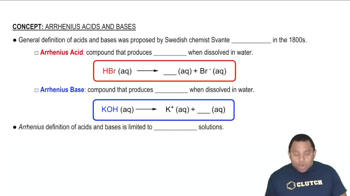
Arrhenius Acids and Bases

Dissociation Constants (Ka and Kb)

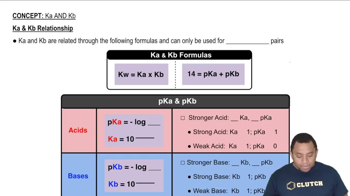
Dissociation constants, such as Ka for acids and Kb for bases, quantify the strength of an acid or base in solution. For HNO2, the given Ka value of 4.5 x 10^-4 indicates its tendency to donate protons. This value is essential for calculating the concentrations of HNO2 and its conjugate base NO2- in equilibrium, as well as for determining the pH of the solution.
Recommended video:
Guided course
03:01
Ka and Kb Relationship

pH Calculation

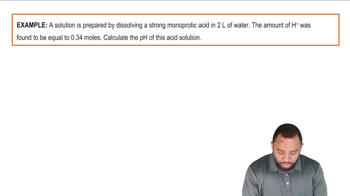
pH is a measure of the acidity or basicity of a solution, defined as the negative logarithm of the hydronium ion concentration (pH = -log[H3O+]). To calculate the pH in this scenario, one must first determine the concentrations of H3O+ produced from the dissociation of HNO2 and HNO3. The pH can then be derived from these concentrations, providing insight into the solution's overall acidity.
Recommended video:
Guided course
02:15
pH Calculation Example
Related Practice
Textbook Question
Which would you expect to be the stronger Lewis acid ineach of the following pairs? Explain.(a) BF3 or BH3
541
views
Textbook Question
Classify each of the following as a Lewis acid or a Lewisbase.(e) OH-
393
views
Textbook Question
In aqueous solution, sodium acetate behaves as a strong electrolyte, yielding Na+ cations and CH3CO2 - anions. A particular solution of sodium acetate has a pH of 9.07 and a density of 1.0085 g/mL. What is the molality of this solution, and what is its freezing point?
1439
views
Textbook Question
Acid and base behavior can be observed in solvents other than water. One commonly used solvent is dimethyl sulfoxide (DMSO), which can be treated as a monoprotic acid 'HSol.' Just as water can behave either as an acid or a base, so HSol can behave either as a Brønsted–Lowry acid or base. (b) The weak acid HCN has an acid dissociation constant Ka = 1.3 * 10-13 in the solvent HSol. If 0.010 mol of NaCN is dissolved in 1.00 L of HSol, what is the equilibrium concentration of H2Sol + ?
922
views
Textbook Question
In the case of very weak acids, 3H3O+ 4 from the dissociation of water is significant compared with 3H3O+ 4 from the dissociation of the weak acid. The sugar substitute saccharin 1C7H5NO3S2, for example, is a very weak acid having Ka = 2.1 * 10-12 and a solubility in water of 348 mg/100 mL. Calculate 3H3O+ 4 in a saturated solution of saccharin. (Hint: Equilibrium equations for the dissociation of saccharin and water must be solved simultaneously.)
437
views