The pH of a solution of NH3 and NH4Br is 8.90. What is the molarity of NH4Br if the molarity of NH3 is 0.016 M?
Verified step by step guidance
1
Identify the relevant chemical equilibrium: \(\text{NH}_3 + \text{H}_2\text{O} \rightleftharpoons \text{NH}_4^+ + \text{OH}^-\). This is the equilibrium for ammonia acting as a base.
Use the given pH to find the pOH: \(\text{pOH} = 14 - \text{pH}\). Calculate the hydroxide ion concentration, \([\text{OH}^-]\), using \([\text{OH}^-] = 10^{-\text{pOH}}\).
Write the expression for the base dissociation constant, \(K_b\), for ammonia: \(K_b = \frac{[\text{NH}_4^+][\text{OH}^-]}{[\text{NH}_3]}\). Use the known \(K_b\) value for ammonia.
Assume that the change in concentration of \(\text{NH}_3\) due to dissociation is negligible, so \([\text{NH}_3] \approx 0.016 \text{ M}\). Substitute \([\text{OH}^-]\) and \([\text{NH}_3]\) into the \(K_b\) expression to solve for \([\text{NH}_4^+]\).
Since \([\text{NH}_4^+]\) comes from the dissociation of \(\text{NH}_4\text{Br}\), the molarity of \(\text{NH}_4\text{Br}\) is equal to \([\text{NH}_4^+]\).
Key Concepts
Here are the essential concepts you must grasp in order to answer the question correctly.
Buffer Solutions
A buffer solution is a system that resists changes in pH upon the addition of small amounts of acid or base. It typically consists of a weak acid and its conjugate base or a weak base and its conjugate acid. In this case, the NH3/NH4Br system acts as a buffer, maintaining a pH of 8.90, which is crucial for understanding the equilibrium between the ammonia and ammonium ions.
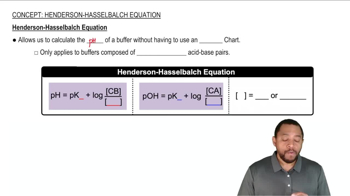
The Henderson-Hasselbalch equation relates the pH of a buffer solution to the concentration of its acidic and basic components. It is expressed as pH = pKa + log([A-]/[HA]), where [A-] is the concentration of the base (NH3) and [HA] is the concentration of the acid (NH4+). This equation is essential for calculating the molarity of NH4Br based on the given pH and the concentration of NH3.
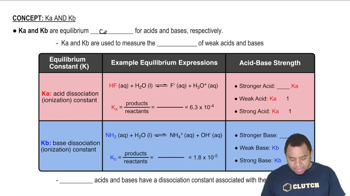
The equilibrium constant (Ka for acids and Kb for bases) quantifies the strength of an acid or base in solution. For NH3, a weak base, its Kb value can be used to find the pKa of its conjugate acid (NH4+). Understanding these values is important for determining the relationship between the concentrations of NH3 and NH4Br in the buffer solution, which ultimately helps in calculating the molarity of NH4Br.


 Verified step by step guidance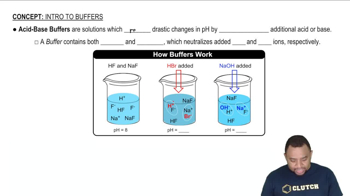
 03:02
03:02