Ch.18 - Thermodynamics: Entropy, Free Energy & Equilibrium
McMurry - Chemistry 8th Edition
McMurry8th EditionChemistryISBN: 9781292336145Not the one you use?Change textbook
Chapter 18, Problem 141b

Consider the unbalanced equation: (b) Use the data in Appendix B and ΔG°f for IO3-(aq)= -128.0 kJ/mol to calculate ΔG° for the reaction at 25 °C.

Verified step by step guidance
1
insert step 1> Identify the balanced chemical equation for the reaction.
insert step 2> Use the standard Gibbs free energy of formation (ΔG°f) values from Appendix B for each reactant and product in the balanced equation.
insert step 3> Calculate the ΔG° for the reaction using the formula: ΔG° = Σ(ΔG°f of products) - Σ(ΔG°f of reactants).
insert step 4> Substitute the given ΔG°f value for IO_3^-(aq) and the values from Appendix B into the equation.
insert step 5> Perform the arithmetic to find the ΔG° for the reaction at 25 °C.

Verified video answer for a similar problem:

This video solution was recommended by our tutors as helpful for the problem above.
Video duration:
2m
Was this helpful?

Key Concepts

Here are the essential concepts you must grasp in order to answer the question correctly.

Gibbs Free Energy (ΔG)

Gibbs Free Energy (ΔG) is a thermodynamic potential that measures the maximum reversible work obtainable from a thermodynamic system at constant temperature and pressure. It is a crucial concept in predicting the spontaneity of a reaction; a negative ΔG indicates that a reaction can occur spontaneously, while a positive ΔG suggests non-spontaneity.
Recommended video:
Guided course
01:51
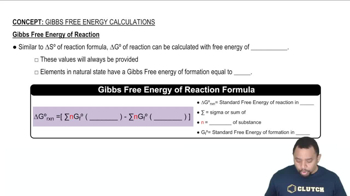
Gibbs Free Energy of Reactions

Standard Gibbs Free Energy of Formation (ΔG°f)

The Standard Gibbs Free Energy of Formation (ΔG°f) is the change in Gibbs free energy when one mole of a compound is formed from its elements in their standard states. This value is essential for calculating the ΔG of a reaction, as it allows for the determination of the energy changes associated with the formation of reactants and products.
Recommended video:
Guided course
00:32
Standard Gibbs Free Energy and Temperature

Reaction Quotient and Equilibrium

The reaction quotient (Q) is a measure of the relative concentrations of products and reactants at any point in a reaction. At equilibrium, Q equals the equilibrium constant (K). Understanding how ΔG relates to Q and K is vital for predicting the direction of a reaction and calculating the ΔG under non-standard conditions.
Recommended video:
Guided course
00:49
Reaction Quotient Q
Related Practice
Textbook Question

Consider the unbalanced equation: I2(s) → I-(aq) + IO3-(aq) (d) What pH is required for the reaction to be at equilibrium at 25°C when [I-] = 0.10M and [IO3-] = 0.50 M?

317
views

Textbook Question

The lead storage battery uses the reaction: (b) Calculate ∆G for this reaction on a cold winter's day (10 °F) in a battery that has run down to the point where the sulfuric acid concentration is only 0.100 M.

366
views
Textbook Question
A mixture of 14.0 g of N2 and 3.024 g of H2 in a 5.00 L container is heated to 400 °C. Use the data in Appendix B to calculate the molar concentrations of N2, H2, and NH3 at equilibrium. Assume that ∆H° and ∆S° are independent of temperature, and remember that the standard state of a gas is defined in terms of pressure.

553
views
Textbook Question

Methanol (CH3OH) is made industrially in two steps from CO and H2. It is so cheap to make that it is being considered for use as a precursor to hydrocarbon fuels, such as methane (CH4):

Step 1. CO(g) + 2 H2(g) S CH3OH(l) ΔS° = - 332 J/K

Step 2. CH3OH1l2 → CH4(g) + 1/2 O2(g) ΔS° = 162 J/K

(k) Calculate an overall ΔG°, ΔH°, and ΔS° for the formation of CH4 from CO and H2.

365
views
Textbook Question
Chloroform has ΔHvaporization = 29.2 kJ>mol and boils at 61.2 °C. What is the value of ΔSvaporization for chloroform?
770
views
Textbook Question

Methanol (CH3OH) is made industrially in two steps from CO and H2. It is so cheap to make that it is being considered for use as a precursor to hydrocarbon fuels, such as methane (CH4):

Step 1. CO(g) + 2 H2(g) S CH3OH(l) ΔS° = - 332 J/K

Step 2. CH3OH1l2 → CH4(g) + 1/2 O2(g) ΔS° = 162 J/K

(m) If you were designing a production facility, would you plan on carrying out the reactions in separate steps or together? Explain.

516
views