
Ch.18 - Thermodynamics: Entropy, Free Energy & Equilibrium
McMurry - Chemistry 8th Edition
McMurry8th EditionChemistryISBN: 9781292336145Not the one you use?Change textbook
Chapter 18, Problem 42

Define entropy, and give an example of a process in which the entropy of a system increases.

Verified step by step guidance
1
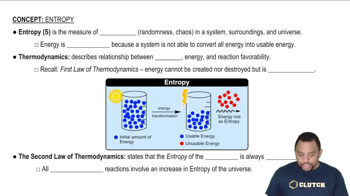
Entropy is a measure of the disorder or randomness in a system. It is a thermodynamic quantity that is often associated with the number of microscopic configurations that correspond to a thermodynamic system's macroscopic state.
In thermodynamics, the second law states that the total entropy of an isolated system can never decrease over time. It can remain constant in ideal cases where the system is in a steady state or undergoing a reversible process.
An example of a process in which the entropy of a system increases is the melting of ice into water. In this process, the structured, orderly arrangement of water molecules in the solid state (ice) becomes more disordered as the molecules move more freely in the liquid state (water).
Another example is the mixing of two gases. When two different gases are allowed to mix, the entropy increases because the molecules of the gases become more randomly distributed throughout the available volume.
In both examples, the increase in entropy reflects the greater number of possible arrangements or configurations of the molecules in the system, leading to a higher degree of disorder.

Key Concepts

Here are the essential concepts you must grasp in order to answer the question correctly.

Entropy

Entropy is a measure of the disorder or randomness in a system. In thermodynamics, it quantifies the number of microscopic configurations that correspond to a thermodynamic system's macroscopic state. Higher entropy indicates greater disorder and less energy available for doing work, reflecting the second law of thermodynamics, which states that the total entropy of an isolated system can never decrease over time.
Recommended video:
Guided course
02:46
Entropy in Thermodynamics

Second Law of Thermodynamics

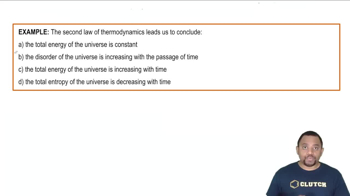
The second law of thermodynamics states that in any energy transfer or transformation, the total entropy of an isolated system will always increase over time. This principle implies that natural processes tend to move towards a state of greater disorder or randomness. It explains why certain processes, such as heat transfer from hot to cold objects, occur spontaneously, leading to an increase in the overall entropy of the universe.
Recommended video:
Guided course
00:48
Second Law of Thermodynamics Example

Example of Increasing Entropy

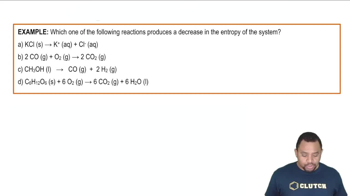
An example of a process in which entropy increases is the melting of ice into water. When ice melts, the structured arrangement of water molecules in the solid state becomes more disordered in the liquid state. This transition from a solid to a liquid increases the entropy of the system, as the molecules have more freedom to move and occupy a greater number of configurations.
Recommended video:
Guided course
01:15
Entropy and Chemical Changes Example
Related Practice
Textbook Question
Predict the sign of the entropy change in the system for each of the following processes.(a) A solid sublimes.(b) A liquid freezes. (c) AgI precipitates from a solution containing Ag+ and I- ions. (d) Gaseous CO2 bubbles out of a carbonated beverage.
600
views
Textbook Question
The following reaction of A3 molecules is spontaneous.

(b) What are the signs of ∆H, ∆S, and ∆G for the reaction? Explain.
276
views
Textbook Question
Consider the distribution of ideal gas molecules among three bulbs (A, B, and C) of equal volume. For each of the follow-ing states, determine the number of ways (W) that the state can be achieved, and use Boltzmann's equation to calculate the entropy of the state. (a) 2 molecules in bulb A(b) 2 molecules randomly distributed among bulbs A, B, and C
714
views
Textbook Question
The following pictures represent equilibrium mixtures for the interconversion of A molecules (red) and X, Y, or Z molecules (blue):

What is the sign of ∆G° for each of the three reactions?
381
views
Textbook Question
Assuming that gaseous reactants and products are present at 1 atm partial pressure, which of the following reactions are spontaneous in the forward direction? (a) (b) (c) (d)
467
views
Textbook Question
Which of the following processes are spontaneous, and which are nonspontaneous?(a) Freezing of water at 2 °C (b) Corrosion of iron metal (c) Expansion of a gas to fill the available volume(d) Separation of an unsaturated aqueous solution of potassium chloride into solid KCl and liquid water
534
views
1
rank