Classify each of the following unbalanced half-reactions as either an oxidation or a reduction. (c) MnO4-(aq) → MnO42-(aq)
Ch.19 - Electrochemistry
Chapter 19, Problem 42b
Classify each of the following unbalanced half-reactions as either an oxidation or a reduction. (b) Pt2+ (aq) → Pt(s)
Verified step by step guidance1
Identify the oxidation states of platinum in both the reactant and the product. In the reactant, Pt has an oxidation state of +2, and in the product, Pt is in its elemental form, which has an oxidation state of 0.
Compare the oxidation states of platinum in the reactant and the product. The oxidation state decreases from +2 in the reactant to 0 in the product.
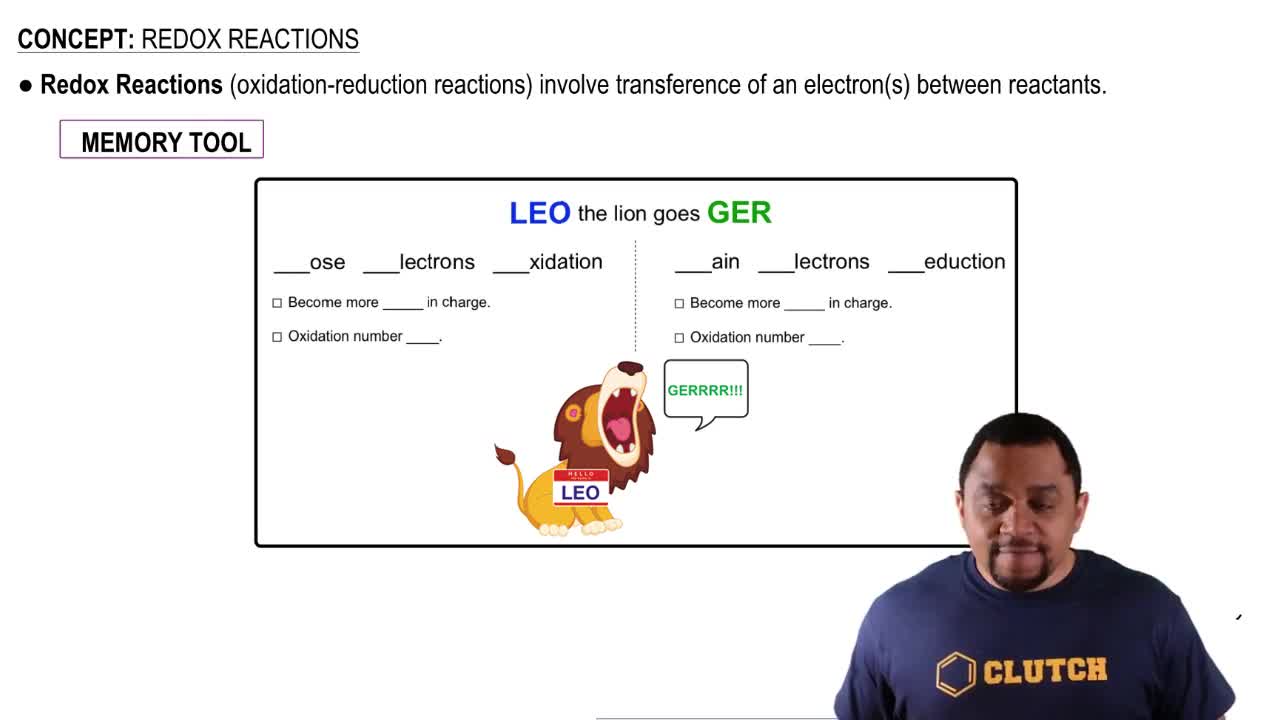
Recall the definition of reduction and oxidation in terms of oxidation states. Reduction involves a decrease in oxidation state, while oxidation involves an increase.
Apply the definitions to the reaction. Since the oxidation state of platinum decreases, this indicates a gain of electrons.
Conclude that the half-reaction Pt2+ (aq) → Pt(s) is a reduction process because it involves a decrease in oxidation state, indicating a gain of electrons.

Verified video answer for a similar problem:
This video solution was recommended by our tutors as helpful for the problem above.
Video duration:
3mWas this helpful?
Key Concepts
Here are the essential concepts you must grasp in order to answer the question correctly.
Oxidation and Reduction
Oxidation and reduction are chemical processes that involve the transfer of electrons between species. Oxidation refers to the loss of electrons, resulting in an increase in oxidation state, while reduction involves the gain of electrons, leading to a decrease in oxidation state. These processes are always coupled, meaning that when one species is oxidized, another must be reduced.
Recommended video:
Guided course
Oxidation and Reduction Reactions
Half-Reactions
Half-reactions are equations that show either the oxidation or reduction process separately. They are useful for balancing redox reactions and understanding the electron transfer involved. Each half-reaction includes the species undergoing oxidation or reduction, along with the electrons gained or lost, allowing for a clearer analysis of the overall reaction.
Identifying Oxidation States
Identifying oxidation states is crucial for determining whether a half-reaction is an oxidation or reduction. The oxidation state of an element in a compound indicates its degree of oxidation. In the given half-reaction, Pt<sup>2+</sup> has a +2 oxidation state, while solid Pt has an oxidation state of 0, indicating that Pt<sup>2+</sup> is being reduced to Pt(s) by gaining electrons.
Recommended video:
Guided course
Oxidation Numbers
Related Practice
Textbook Question
412
views
Textbook Question
Sketch a cell with inert electrodes suitable for electrolysis of aqueous CuBr2. (b) Indicate the direction of electron and ion flow.
659
views
Textbook Question
Classify each of the following unbalanced half-reactions as either an oxidation or a reduction. (d) CH3O→H(aq) CH2O(aq)
431
views
Textbook Question
Classify each of the following unbalanced half-reactions as either an oxidation or a reduction. (b) H2O2(aq) → O2(g)
379
views
Textbook Question
Porous pellets of TiO2 can be reduced to titanium metal at the cathode of an electrochemical cell containing molten CaCl2 as the electrolyte. When the TiO2 is reduced, the O2-ions dis-solve in the CaCl2 and are subsequently oxidized to O2 gas at the anode. This approach may be the basis for a less expensive process than the one currently used for producing titanium.
(c) Write balanced equations for the anode, cathode, and overall cell reactions.
618
views
Textbook Question
Consider a Daniell cell with 1.0 M ion concentrations: Does the cell voltage increase, decrease, or remain the same when each of the following changes is made? Explain. (a) Write a balanced equation for each cell reaction.
1009
views