

Ch.19 - Electrochemistry
McMurry - Chemistry 8th Edition
McMurry8th EditionChemistryISBN: 9781292336145Not the one you use?Change textbook
Chapter 19, Problem 159

Consider a galvanic cell that utilizes the following half-reactions:Table showing standard enthalpy and entropy values for various substances in electrochemistry.
(b) What are the values of E° and the equilibrium constant K for the cell reaction at 25 °C?

Verified step by step guidance
1
Identify the half-reactions involved in the galvanic cell and write their standard reduction potentials (E°).
Use the Nernst equation to calculate the standard cell potential (E°cell) by combining the half-reactions.
Write the overall balanced equation for the cell reaction.
Use the relationship between E°cell and the equilibrium constant K: E°cell = (RT/nF)lnK, where R is the gas constant, T is the temperature in Kelvin, n is the number of moles of electrons transferred, and F is Faraday's constant.
Solve for the equilibrium constant K using the calculated E°cell and the given temperature of 25 °C (298 K).

Verified video answer for a similar problem:

This video solution was recommended by our tutors as helpful for the problem above.
Video duration:
9m
Was this helpful?

Key Concepts

Here are the essential concepts you must grasp in order to answer the question correctly.

Galvanic Cell

A galvanic cell is an electrochemical cell that converts chemical energy into electrical energy through spontaneous redox reactions. It consists of two half-cells, each containing an electrode and an electrolyte. The flow of electrons from the anode to the cathode generates an electric current, and the cell potential (E°) can be calculated using standard reduction potentials.

Standard Electrode Potential (E°)

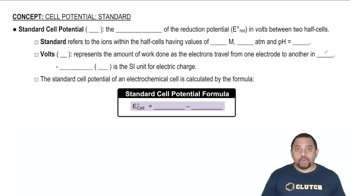
The standard electrode potential (E°) is a measure of the tendency of a chemical species to be reduced, measured under standard conditions (1 M concentration, 1 atm pressure, and 25 °C). It is expressed in volts and is used to predict the direction of electron flow in electrochemical cells. The overall cell potential can be determined by subtracting the anode potential from the cathode potential.
Recommended video:
Guided course
01:27
Standard Cell Potential

Equilibrium Constant (K)

The equilibrium constant (K) is a dimensionless value that expresses the ratio of the concentrations of products to reactants at equilibrium for a given reaction at a specific temperature. In electrochemistry, K can be related to the cell potential (E°) using the Nernst equation, indicating the extent to which a reaction favors products over reactants. A larger K value suggests a more favorable reaction.
Recommended video:
Guided course
01:14
Equilibrium Constant K
Related Practice
Textbook Question

The reaction of MnO4 with oxalic acid (H2C2O4) in acidic solution, yielding Mn2+ and CO2 gas, is widely used to determine the concentration of permanganate solutions. (b) Use the data in Appendix D to calculate E° for the reaction. (c) Show that the reaction goes to completion by calculating the values of ∆G° and K at 25 °C. (H2C2O4) in acidic solution, yielding Mn2+ and CO2 gas, is widely used to determine the concentration of permanganate solutions.

1
views
Textbook Question

The half-reactions that occur in ordinary alkaline batteries can be written as In 1999, researchers in Israel reported a new type of alkaline battery, called a 'super-iron' battery. This battery uses the same anode reaction as an ordinary alkaline battery but involves the reduction of FeO42- ion (from K2FeO4) to solid Fe(OH)3 at the cathode. (a) Use the following standard reduction potential and any data from Appendixes C and D to calculate the standard cell potential expected for an ordinary alkaline battery:

798
views
Textbook Question

Experimental solid-oxide fuel cells that use butane (C4H10) as the fuel have been reported recently. These cells contain composite metal/metal oxide electrodes and a solid metal oxide electrolyte. The cell half-reactions are (b) Use the thermodynamic data in Appendix B to calculate the values of E° and the equilibrium constant K for the cell reaction at 25 °C. Will E° and K increase, decrease, or remain the same on raising the temperature?

300
views
Textbook Question

Consider the redox titration (Section 4.13) of 120.0 mL of 0.100 M FeSO4 with 0.120 M K2Cr2O7 at 25 °C, assuming that the pH of the solution is maintained at 2.00 with a suitable buffer. The solution is in contact with a platinum electrode and constitutes one half-cell of an electrochemical cell. The other half-cell is a standard hydrogen electrode. The two half-cells are connected with a wire and a salt bridge, and the progress of the titration is monitored by measuring the cell potential with a voltmeter. (a) Write a balanced net ionic equation for the titration reaction, assuming that the products are Fe3+ and Cr3+.

370
views
Textbook Question
The nickel–iron battery has an iron anode, an NiO(OH) cathode, and a KOH electrolyte. This battery uses the follow-ing half-reactions and has an E° value of 1.37 V at 25 °C. (b) Calculate ∆G° (in kilojoules) and the equilibrium con-stant K for the cell reaction at 25 °C.
1005
views
Textbook Question

The reaction of MnO4 with oxalic acid (H2C2O4) in acidic solution, yielding Mn2+ and CO2 gas, is widely used to determine the concentration of permanganate solutions. (d) A 1.200 g sample of sodium oxalate (Na2C2O4) is dissolved in dilute H2SO4 and then titrated with a KMnO4 solution. If 32.50 mL of the KMnO4 solution is required to reach the equivalence point, what is the molarity of the KMnO4 solution?

1607
views