Ch.19 - Electrochemistry
McMurry - Chemistry 8th Edition
McMurry8th EditionChemistryISBN: 9781292336145Not the one you use?Change textbook
Chapter 19, Problem 100

The Nernst equation applies to both cell reactions and half-reactions. For the conditions specified, calculate the potential for the following half-reactions at 25 °C.(b)

Verified step by step guidance
1
Identify the half-reaction for which you need to calculate the potential. Write down the balanced half-reaction equation.
Use the Nernst equation for half-reactions: \(E = E^0 - \frac{RT}{nF} \ln Q\), where \(E\) is the cell potential, \(E^0\) is the standard cell potential, \(R\) is the universal gas constant (8.314 J/mol·K), \(T\) is the temperature in Kelvin, \(n\) is the number of moles of electrons transferred, \(F\) is Faraday's constant (96485 C/mol), and \(Q\) is the reaction quotient.
Convert the temperature from Celsius to Kelvin by adding 273.15 to the given temperature (25 °C).
Determine the number of electrons transferred (\(n\)) in the half-reaction by examining the change in oxidation states of the elements involved.
Calculate the reaction quotient (\(Q\)) using the concentrations or partial pressures of the reactants and products involved in the half-reaction.

Verified video answer for a similar problem:

This video solution was recommended by our tutors as helpful for the problem above.
Video duration:
4m
Was this helpful?

Key Concepts

Here are the essential concepts you must grasp in order to answer the question correctly.

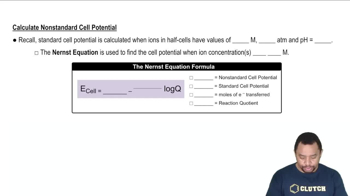
Nernst Equation

The Nernst equation relates the reduction potential of a half-reaction to the standard electrode potential, temperature, and the concentrations of reactants and products. It is expressed as E = E° - (RT/nF) ln(Q), where E is the cell potential, E° is the standard potential, R is the gas constant, T is the temperature in Kelvin, n is the number of moles of electrons transferred, F is Faraday's constant, and Q is the reaction quotient.
Recommended video:
Guided course
01:17
The Nernst Equation

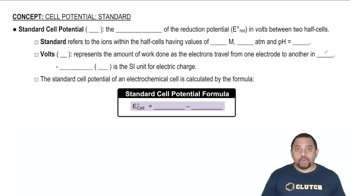
Standard Electrode Potential

Standard electrode potential (E°) is the measure of the intrinsic ability of a half-reaction to gain electrons under standard conditions (1 M concentration, 1 atm pressure, and 25 °C). It serves as a reference point for calculating the potential of electrochemical cells and is crucial for determining the direction of spontaneous reactions.
Recommended video:
Guided course
01:27
Standard Cell Potential

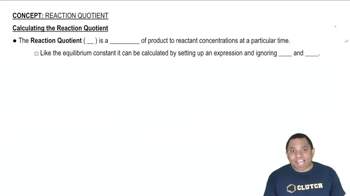
Reaction Quotient (Q)

The reaction quotient (Q) is a dimensionless number that reflects the ratio of the concentrations of products to reactants at any point in a reaction, raised to the power of their stoichiometric coefficients. It is used in the Nernst equation to account for the current state of the reaction, allowing for the calculation of the cell potential under non-standard conditions.
Recommended video:
Guided course
00:49
Reaction Quotient Q