
Ch.20 - Nuclear Chemistry
McMurry - Chemistry 8th Edition
McMurry8th EditionChemistryISBN: 9781292336145Not the one you use?Change textbook
Chapter 20, Problem 70

Uranium-238 has a half-life of 4.47 * 109 years and decays through a series of events to yield lead-206. Estimate the age of a rock that contains 105 mmol of 238U and 33 mmol of 206Pb. Assume all the 206Pb is from the decay of 238U.

Verified step by step guidance
1
Determine the initial amount of 238U. Since all the 206Pb is from the decay of 238U, the initial amount of 238U would be the sum of the current amounts of 238U and 206Pb.
Calculate the ratio of remaining 238U to the initial amount of 238U. This is done by dividing the current amount of 238U by the initial amount calculated in the first step.
Use the half-life formula to relate the ratio calculated in step 2 to the number of half-lives that have passed. The formula is: \( N = N_0 \times (\frac{1}{2})^{t/T} \), where \( N \) is the remaining amount, \( N_0 \) is the initial amount, \( t \) is the time elapsed, and \( T \) is the half-life.
Solve the equation from step 3 for \( t \), the time elapsed, which represents the age of the rock. Rearrange the formula to isolate \( t \): \( t = T \times \frac{\log(N/N_0)}{\log(1/2)} \).
Substitute the values for \( N \), \( N_0 \), and \( T \) into the rearranged formula to calculate the age of the rock.

Verified video answer for a similar problem:

This video solution was recommended by our tutors as helpful for the problem above.
Video duration:
5m
Was this helpful?

Key Concepts

Here are the essential concepts you must grasp in order to answer the question correctly.

Half-life

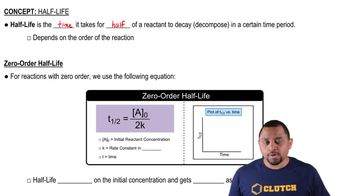
Half-life is the time required for half of the radioactive nuclei in a sample to decay. For Uranium-238, this period is approximately 4.47 billion years. Understanding half-life is crucial for estimating the age of geological samples, as it allows us to calculate how many half-lives have passed based on the ratio of parent isotopes (U-238) to daughter isotopes (Pb-206).
Recommended video:
Guided course
02:17
Zero-Order Half-life

Radioactive decay

Radioactive decay is the process by which unstable atomic nuclei lose energy by emitting radiation, resulting in the transformation of the original element into a different element or isotope. In this case, Uranium-238 decays into Lead-206 through a series of intermediate isotopes. This concept is essential for understanding how the initial amount of U-238 relates to the amount of Pb-206 present in the rock sample.

Isotope ratio

The isotope ratio compares the quantities of different isotopes of an element in a sample. In this scenario, the ratio of Uranium-238 to Lead-206 is used to determine the age of the rock. By knowing the initial amount of U-238 and the amount of Pb-206 produced from its decay, we can apply the half-life to calculate how long the decay process has been occurring, thus estimating the rock's age.
Recommended video:
Guided course
02:14
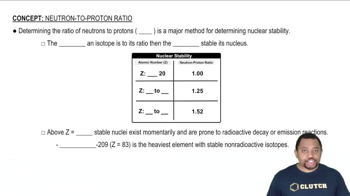
Neutron-Proton Ratio
Related Practice
Textbook Question
Potassium ion, K+, is present in most foods and is an essen-tial nutrient in the human body. Potassium-40, however, which has a natural abundance of 0.0117%, is radioactive with t1/2 = 1.25 x 10^9 years. What is the decay constant of 40K? How many 40K+ ions are present in 1.00 g of KCl? How many disintegration/s does 1.00 g of KCl undergo?
682
views
Textbook Question
Calculate the mass defect (in g/mol) and the binding energy (in MeV/nucleon) for the following nuclei. Which of the two is more stable? (a) 50Cr (atomic mass = 49.94605)(b) 64Zn (atomic mass = 63.92915)
802
views
Textbook Question
The age of an igneous rock that has solidified from magma can be found by analyzing the amount of 40K and 40Ar. Potassium-40 emits a positron to produce argon-40 and the half-life of 40K is 1.25 * 109 years. What is the age of a rock whose 40Ar/40K ratio is 1.42?
648
views
Textbook Question
Why does a given nucleus have less mass than the sum of its constituent protons and neutrons?
378
views
Textbook Question
The electronic systems on the New Horizons spacecraft, which launched on January 19, 2006, and reached its closest approach to Pluto on July 14, 2015, were powered by elec-tricity generated by heat. The heat came from the radioac-tive decay of 238Pu in the 11 kg of 238PuO2 fuel onboard. The generator provided 240 W when the spacecraft was launched. If the power output is directly proportional to the amount of 238Pu in the generator, what was the power output when the spacecraft reached Pluto? The half-life of 238Pu is 87.7 y.
304
views