Ch.2 - Atoms, Molecules & Ions
McMurry - Chemistry 8th Edition
McMurry8th EditionChemistryISBN: 9781292336145Not the one you use?Change textbook
Chapter 2, Problem 81

In borane, one part hydrogen combines with 3.6 parts boron by mass. A compound containing only hydrogen and boron contains 6.0 g of hydrogen and 43.2 g of boron. Could this compound be borane? If it is not borane, show that the law of multiple proportions is followed for borane and this other substance.

Verified step by step guidance
1
Calculate the mass ratio of boron to hydrogen in the given compound by dividing the mass of boron by the mass of hydrogen: \( \text{Mass ratio} = \frac{43.2 \text{ g B}}{6.0 \text{ g H}} \).
Compare the calculated mass ratio from the compound to the mass ratio given for borane (3.6 parts boron to 1 part hydrogen).
If the mass ratio from the compound matches the mass ratio for borane, then the compound could be borane. If not, proceed to the next step.
To show the law of multiple proportions, calculate the ratio of the two mass ratios (the one from the compound and the one for borane).
If the ratio of the two mass ratios is a simple whole number, then the law of multiple proportions is followed, indicating that the compound is a different boron-hydrogen compound.

Key Concepts

Here are the essential concepts you must grasp in order to answer the question correctly.

Law of Definite Proportions

The Law of Definite Proportions states that a chemical compound always contains its component elements in fixed ratio by mass, regardless of the sample size or source. In the case of borane, the mass ratio of hydrogen to boron is consistent, which is essential for identifying whether a given sample can be classified as borane.

Law of Multiple Proportions

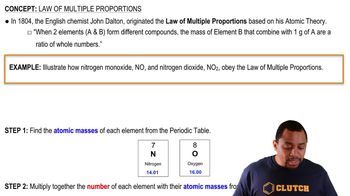
The Law of Multiple Proportions asserts that when two elements form more than one compound, the ratios of the masses of one element that combine with a fixed mass of the other element can be expressed as small whole numbers. This principle can be applied to compare borane with another hydrogen-boron compound to demonstrate that they adhere to this law.
Recommended video:
Guided course
03:32
Law of Multiple Proportions

Molar Mass and Stoichiometry

Molar mass is the mass of one mole of a substance, typically expressed in grams per mole. Understanding stoichiometry allows us to calculate the mass ratios of elements in compounds. By determining the molar masses of hydrogen and boron, we can analyze the mass ratios in the given compound and compare them to those in borane to assess whether they are consistent.
Recommended video:
Guided course
02:11
Molar Mass Concept