Ch.2 - Atoms, Molecules & Ions
McMurry - Chemistry 8th Edition
McMurry8th EditionChemistryISBN: 9781292336145Not the one you use?Change textbook
Chapter 2, Problem 96

What is the difference between an atom's atomic number and its mass number?

Verified step by step guidance
1
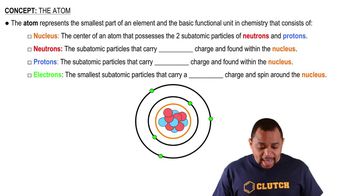
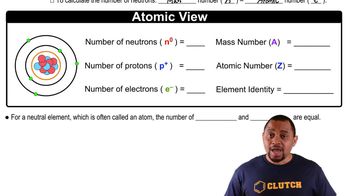
Understand that the atomic number of an atom is the number of protons in the nucleus of the atom. It is denoted by the symbol Z.
Recognize that the mass number of an atom is the total number of protons and neutrons in the nucleus. It is denoted by the symbol A.
Note that the atomic number (Z) is unique to each element and determines the element's identity on the periodic table.
Realize that the mass number (A) is not unique to each element because isotopes of an element have the same atomic number but different mass numbers due to varying numbers of neutrons.
Remember that the difference between the mass number and the atomic number gives the number of neutrons in the atom: Neutrons = Mass Number (A) - Atomic Number (Z).

Verified video answer for a similar problem:

This video solution was recommended by our tutors as helpful for the problem above.
Video duration:
1m
Was this helpful?

Key Concepts

Here are the essential concepts you must grasp in order to answer the question correctly.

Atomic Number

The atomic number of an element is the number of protons found in the nucleus of an atom. It uniquely identifies an element and determines its position on the periodic table. For example, hydrogen has an atomic number of 1, indicating it has one proton. The atomic number also defines the element's chemical properties and its identity.
Recommended video:
Guided course
02:10
Atom Structure

Mass Number

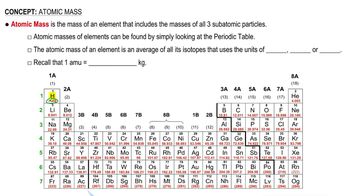
The mass number is the total number of protons and neutrons in an atom's nucleus. It reflects the mass of the atom and is not unique to an element, as different isotopes of the same element can have different mass numbers. For instance, carbon-12 has a mass number of 12, while carbon-14 has a mass number of 14 due to the presence of additional neutrons.
Recommended video:

Isotopes

Isotopes are variants of a particular chemical element that have the same number of protons but different numbers of neutrons, resulting in different mass numbers. For example, both carbon-12 and carbon-14 are isotopes of carbon, with carbon-12 having 6 neutrons and carbon-14 having 8 neutrons. Isotopes can exhibit different physical properties and stability, influencing their applications in fields like medicine and archaeology.
Recommended video: