
In the following drawings, red and blue spheres represent atoms of different elements. Match the molecular pictures (a)–(c) with the following descriptions: (i) a pure substance consisting of a compound (ii) a pure substance consisting of an element (iii) a mixture of element
Ch.2 - Atoms, Molecules & Ions
Chapter 2, Problem 41c
Which represents an F atom with one minus charge (F-)? (a)
(b)
(c)
Verified step by step guidance1
Identify the atomic number of fluorine (F) from the periodic table, which is 9.
Understand that a neutral fluorine atom has 9 protons and 9 electrons.
Recognize that an F atom with a one minus charge (F-) means it has gained an extra electron.
Calculate the total number of electrons in F- by adding one electron to the neutral atom's electron count, resulting in 10 electrons.
Conclude that F- has 9 protons and 10 electrons, representing a fluoride ion.

Verified video answer for a similar problem:
This video solution was recommended by our tutors as helpful for the problem above.
Video duration:
1mWas this helpful?
Key Concepts
Here are the essential concepts you must grasp in order to answer the question correctly.
Atomic Structure
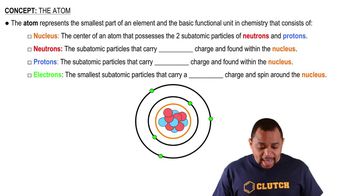
An atom consists of a nucleus containing protons and neutrons, surrounded by electrons in various energy levels. The number of protons defines the element, while electrons determine its charge. For an F atom, there are 9 protons and typically 9 electrons, resulting in a neutral charge.
Recommended video:
Guided course
Atom Structure
Ionic Charge
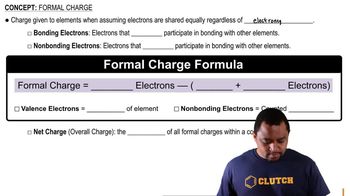
An ionic charge occurs when an atom gains or loses electrons, resulting in a net charge. An F atom with a one minus charge (F-) has gained an extra electron, bringing its total to 10 electrons. This additional electron gives the atom a negative charge, indicating it is an anion.
Recommended video:
Guided course
Formal Charge
Electron Configuration
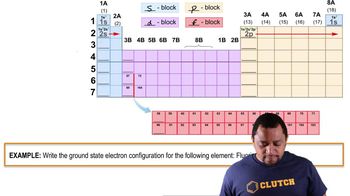
Electron configuration describes the distribution of electrons in an atom's orbitals. For a neutral fluorine atom, the configuration is 1s² 2s² 2p⁵. When it becomes F-, the configuration changes to 1s² 2s² 2p⁶, indicating a full outer shell, which is a stable arrangement.
Recommended video:
Guided course
Electron Configuration Example
Related Practice
Textbook Question
777
views
Textbook Question
Which of the following three drawings represents a neutral Na atom? (a) (b) (c)
329
views
Textbook Question
Give molecular formulas corresponding to each of the following ball-and-stick molecular representations (red = O, gray = C, blue = N, ivory = H). In writing the formula, list the elements in alphabetical order. (c) Acetic acid (vinegar)
354
views
Textbook Question
Give molecular formulas corresponding to each of the following ball-and-stick molecular representations (red = O, gray = C, blue = N, ivory = H). In writing the formula, list the elements in alphabetical order. (b) Ethylene glycol (automobile antifreeze)
573
views
Textbook Question
Which represents a Ca atom with two positive electrical charges (Ca2+)? (a)
(b)
(c)
318
views
Textbook Question
In the following drawings, red spheres represent protons, and blue spheres represent neutrons. Which of the draw-ings represent different isotopes of the same element, and which represents a different element altogether?(a) (b) (c)
474
views
