Ch.21 - Transition Elements and Coordination Chemistry
McMurry - Chemistry 8th Edition
McMurry8th EditionChemistryISBN: 9781292336145Not the one you use?Change textbook
Chapter 21, Problem 27b

Look at the location in the periodic table of elements A, B, C, and D. What is the electron configuration of the transition metal in each of the following ions?
(c) C3+
(d) DO42-

Verified step by step guidance
1
insert step 1> Identify the elements C and D based on their positions in the periodic table. Transition metals are typically found in the d-block, which includes groups 3 to 12.
insert step 2> Determine the neutral electron configuration of element C. Transition metals often have electron configurations that end in the d subshell.
insert step 3> For the ion C3+, remove three electrons from the neutral electron configuration of element C. Electrons are typically removed from the outermost shell first, which may include the s and then the d subshell.
insert step 4> Determine the neutral electron configuration of element D. Since DO42- is an ion, identify the transition metal within this polyatomic ion.
insert step 5> For the ion DO42-, add two electrons to the neutral electron configuration of element D. This will typically involve adding electrons to the outermost shell, which may include the d subshell.

Verified video answer for a similar problem:

This video solution was recommended by our tutors as helpful for the problem above.
Was this helpful?

Key Concepts

Here are the essential concepts you must grasp in order to answer the question correctly.

Electron Configuration

Electron configuration describes the distribution of electrons in an atom's orbitals. It follows the Aufbau principle, which states that electrons fill lower-energy orbitals first, and is represented using a notation that indicates the energy levels and sublevels occupied by electrons. Understanding electron configuration is crucial for predicting the chemical behavior and properties of elements, especially transition metals.
Recommended video:
Guided course
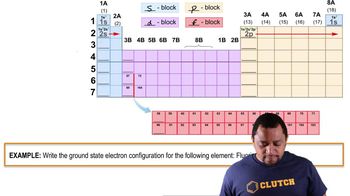
01:33
Electron Configuration Example

Transition Metals

Transition metals are elements found in the d-block of the periodic table, characterized by their ability to form variable oxidation states and complex ions. They typically have partially filled d orbitals, which contribute to their unique properties, such as catalytic activity and the formation of colored compounds. Recognizing the specific transition metal involved is essential for determining the correct electron configuration in ions.
Recommended video:
Guided course
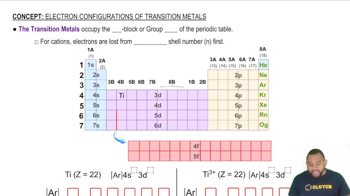
03:12
Transition Metals

Ionic Charge and Electron Loss

The ionic charge of an element indicates the number of electrons lost or gained when it forms an ion. For cations, such as C3+, electrons are removed from the outermost shell, while for anions, like DO42-, electrons are added. Understanding how to adjust the electron configuration based on the ionic charge is vital for accurately determining the electron configurations of ions.
Recommended video:
Guided course
01:53
Formal Charge
Related Practice
Textbook Question

In acidic aqueous solution, the complex trans-[Co(en)2Cl1]2+(aq) undergoes the following substitution reaction:

trans-[Co(en)2Cl1]+(aq) + H2O(l) → trans-[Co(en)2(H2O)Cl]2+(aq) + Cl(aq)

The reaction is first order in trans-[Co(en)2Cl2]+(aq), and the rate constant at 25°C is 3.2×10⁻⁵ s–1.

e. Draw a crystal field energy-level diagram for trans-[Co(en)2Cl2]+ that takes account of the fact that Cl is a weaker-field ligand than ethylenediamine.

82
views
Textbook Question

Locate on the periodic table the transition elements with the following electron configurations. Identify each element.

(a) [Ar] 3d74s2

(b) [Ar] 3d54s1

96
views
Textbook Question

Locate on the periodic table the transition elements with the following electron configurations. Identify each element.

(c) [Kr] 4d25s2

(d) [Xe] 4f36s2

90
views
Textbook Question

What is the systematic name for each of the following molecules or ions? Include cis or trans prefixes for diastereoisomers. Platinum is Pt(II) in square planar complexes and Pt(IV) in octahedral complexes.

(1)

(2)

(3)

(4)

71
views

Textbook Question

Consider the following isomers [Cr(NH3)2Cl4]-.

(a) Label the isomers as cis or trans.

(b) Which isomers are identical, and which are different?

(c) Do any of these isomers exist as enantiomers? Explain.

103
views
Textbook Question

Consider the following ethylenediamine complexes.

(a) Which complexes are chiral, and which are achiral?

(b) Draw the enantiomer of each chiral complex.

(c) Which, if any, of the chiral complexes are enantiomers of one another?

112
views