Ch.22 - The Main Group Elements

McMurry8th EditionChemistryISBN: 9781292336145
Not the one you use?Change textbookSelect a different textbook
Table of contents
- Ch.1 - Chemical Tools: Experimentation & Measurement143
- Ch.2 - Atoms, Molecules & Ions134
- Ch.3 - Mass Relationships in Chemical Reactions149
- Ch.4 - Reactions in Aqueous Solution157
- Ch.5 - Periodicity & Electronic Structure of Atoms92
- Ch.6 - Ionic Compounds: Periodic Trends and Bonding Theory73
- Ch.7 - Covalent Bonding and Electron-Dot Structures47
- Ch.8 - Covalent Compounds: Bonding Theories and Molecular Structure51
- Ch.9 - Thermochemistry: Chemical Energy104
- Ch.10 - Gases: Their Properties & Behavior138
- Ch.11 - Liquids & Phase Changes43
- Ch.12 - Solids and Solid-State Materials56
- Ch.13 - Solutions & Their Properties98
- Ch.14 - Chemical Kinetics79
- Ch.15 - Chemical Equilibrium107
- Ch.16 - Aqueous Equilibria: Acids & Bases94
- Ch.17 - Applications of Aqueous Equilibria125
- Ch.18 - Thermodynamics: Entropy, Free Energy & Equilibrium66
- Ch.19 - Electrochemistry130
- Ch.20 - Nuclear Chemistry73
- Ch.21 - Transition Elements and Coordination Chemistry122
- Ch.22 - The Main Group Elements155
- Ch.23 - Organic and Biological Chemistry43

Chapter 22, Problem 149
Niobium reacts with fluorine at room temperature to give a solid binary compound that is 49.44% Nb by mass. (a) What is the empirical formula of the compound? (b) Write a balanced equation for the reaction.
 Verified step by step guidance
1
Step 1: Determine the mass percentage of fluorine in the compound. Since the compound is 49.44% niobium (Nb) by mass, the percentage of fluorine (F) is 100% - 49.44% = 50.56%.
Step 2: Convert the mass percentages to moles. Assume you have 100 grams of the compound. This means you have 49.44 grams of Nb and 50.56 grams of F. Use the molar masses: Nb (92.91 g/mol) and F (19.00 g/mol) to convert grams to moles. Calculate moles of Nb: \( \text{moles of Nb} = \frac{49.44}{92.91} \) and moles of F: \( \text{moles of F} = \frac{50.56}{19.00} \).
Step 3: Determine the simplest whole number ratio of moles of Nb to moles of F. Divide the moles of each element by the smallest number of moles calculated in Step 2 to find the ratio.
Step 4: Write the empirical formula based on the mole ratio obtained in Step 3. The empirical formula is the simplest whole number ratio of atoms in the compound.
Step 5: Write a balanced chemical equation for the reaction of niobium with fluorine. Use the empirical formula from Step 4 to determine the product, and balance the equation by ensuring the number of atoms of each element is the same on both sides of the equation.
Key Concepts
Here are the essential concepts you must grasp in order to answer the question correctly.
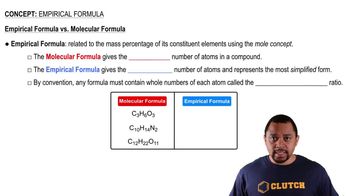
Empirical Formula
The empirical formula represents the simplest whole-number ratio of the elements in a compound. To determine it, one must first convert the percentage composition of each element into moles, then simplify the mole ratio to the smallest integers. In this case, knowing that the compound is 49.44% niobium by mass allows for the calculation of the ratio of niobium to fluorine.
Recommended video:
Guided course
 02:26
02:26
Empirical vs Molecular Formula
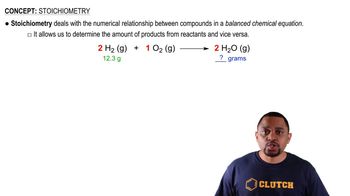
Stoichiometry
Stoichiometry is the branch of chemistry that deals with the quantitative relationships between the reactants and products in a chemical reaction. It involves using balanced chemical equations to determine the amounts of substances consumed and produced. For this question, stoichiometry will be essential in writing the balanced equation for the reaction between niobium and fluorine.
Recommended video:
Guided course
 01:16
01:16Stoichiometry Concept
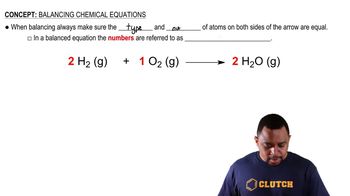
Balancing Chemical Equations
Balancing chemical equations is the process of ensuring that the number of atoms for each element is the same on both sides of the equation. This is crucial for obeying the law of conservation of mass. In the context of this question, one must account for the reactants (niobium and fluorine) and the products formed to create a balanced equation that accurately represents the reaction.
Recommended video:
Guided course
 01:32
01:32Balancing Chemical Equations
Related Practice