Ch.3 - Mass Relationships in Chemical Reactions
McMurry - Chemistry 8th Edition
McMurry8th EditionChemistryISBN: 9781292336145Not the one you use?Change textbook
Chapter 3, Problem 117a

A copper wire having a mass of 2.196 g was allowed to react with an excess of sulfur. The excess sulfur was then burned, yielding SO2 gas. The mass of the copper sulfide produced was 2.748 g. (a) What is the percent composition of copper sulfide?

Verified step by step guidance
1
Determine the mass of sulfur that reacted by subtracting the mass of copper from the mass of copper sulfide: \( \text{mass of sulfur} = \text{mass of copper sulfide} - \text{mass of copper} \).
Calculate the percent composition of copper in the copper sulfide by dividing the mass of copper by the mass of copper sulfide and multiplying by 100: \( \%\text{Cu} = \left( \frac{\text{mass of copper}}{\text{mass of copper sulfide}} \right) \times 100 \).
Calculate the percent composition of sulfur in the copper sulfide by dividing the mass of sulfur by the mass of copper sulfide and multiplying by 100: \( \%\text{S} = \left( \frac{\text{mass of sulfur}}{\text{mass of copper sulfide}} \right) \times 100 \).
Verify that the sum of the percent compositions of copper and sulfur equals 100% to ensure the calculations are correct.
Summarize the percent composition of copper sulfide, listing the percent of copper and the percent of sulfur.

Key Concepts

Here are the essential concepts you must grasp in order to answer the question correctly.

Percent Composition

Percent composition refers to the percentage by mass of each element in a compound. It is calculated by dividing the mass of the element in the compound by the total mass of the compound and then multiplying by 100. This concept is essential for determining the contribution of each element to the overall mass of a compound, which is crucial for solving the given problem.

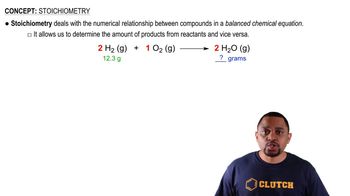
Stoichiometry

Stoichiometry is the branch of chemistry that deals with the quantitative relationships between the reactants and products in a chemical reaction. It allows chemists to predict the amounts of substances consumed and produced in a reaction based on balanced chemical equations. Understanding stoichiometry is vital for calculating the mass of copper sulfide produced from the reaction of copper and sulfur.
Recommended video:
Guided course
01:16
Stoichiometry Concept

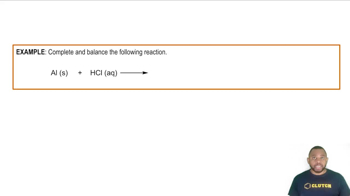
Chemical Reaction and Products

A chemical reaction involves the transformation of reactants into products, often accompanied by a change in mass. In this case, copper reacts with sulfur to form copper sulfide (CuS). Recognizing the nature of the reaction and the products formed is crucial for determining the mass changes and calculating the percent composition of the resulting compound.
Recommended video:
Guided course
01:30
Production of Hydrogen Example
Related Practice
Textbook Question

A mixture of FeO and Fe2O3 with a mass of 10.0 g is con-verted to 7.43 g of pure Fe metal. What are the amounts in grams of FeO and Fe2O3 in the original sample?

1042
views
2
comments

Textbook Question

A copper wire having a mass of 2.196 g was allowed to react with an excess of sulfur. The excess sulfur was then burned, yielding SO2 gas. The mass of the copper sulfide produced was 2.748 g. (b) What is its empirical formula?

550
views
Textbook Question

A compound of formula XCl3 reacts with aqueous AgNO3 to yield solid AgCl according to the following equation: When a solution containing 0.634 g of XCl3 was allowed to react with an excess of aqueous AgNO3, 1.68 g of solid AgCl was formed. What is the identity of the atom X?

337
views
Textbook Question

Ammonium nitrate, a potential ingredient of terrorist bombs, can be made nonexplosive by addition of diammo-nium hydrogen phosphate, (NH4)2HPO4. Analysis of such a NH4NO3 - (NH4)2HPO4 mixture showed the mass percent of nitrogen to be 30.43%. What is the mass ratio of the two components in the mixture?

720
views
Textbook Question
A certain alcoholic beverage contains only ethanol (C2H6O) and water. When a sample of this beverage undergoes com-bustion, the ethanol burns but the water simply evaporates and is collected along with the water produced by combus-tion. The combustion reaction is When a 10.00 g sample of this beverage is burned, 11.27 g of water is collected. What is the mass in grams of ethanol, and what is the mass of water in the original sample?
709
views