

Ch.3 - Mass Relationships in Chemical Reactions
McMurry - Chemistry 8th Edition
McMurry8th EditionChemistryISBN: 9781292336145Not the one you use?Change textbook
Chapter 3, Problem 121

Window glass is typically made by mixing soda ash (Na2CO3), limestone (CaCO3), and silica sand (SiO2) and then heating to 1500 °C to drive off CO2 from the (Na2CO3) and CaCO3. The resultant glass consists of about 12% Na2O by mass, 13% CaO by mass, and 75% SiO2 by mass. How much of each reactant would you start with to prepare 0.35 kg of glass?

Verified step by step guidance
1
Step 1: Determine the mass of each component in the final glass.
Step 2: Calculate the moles of each oxide in the glass using their molar masses.
Step 3: Use stoichiometry to find the moles of each reactant needed to produce the calculated moles of oxides.
Step 4: Convert the moles of each reactant back to mass using their respective molar masses.
Step 5: Sum the masses of the reactants to ensure they add up to the total mass of the glass.

Verified video answer for a similar problem:

This video solution was recommended by our tutors as helpful for the problem above.
Video duration:
10m
Was this helpful?

Key Concepts

Here are the essential concepts you must grasp in order to answer the question correctly.

Stoichiometry

Stoichiometry is the calculation of reactants and products in chemical reactions based on the conservation of mass. It involves using balanced chemical equations to determine the proportions of substances needed or produced in a reaction. Understanding stoichiometry is essential for determining how much of each reactant is required to produce a specific amount of product, such as glass in this case.
Recommended video:
Guided course
01:16
Stoichiometry Concept

Mass Percent Composition

Mass percent composition refers to the percentage by mass of each component in a compound. It is calculated by dividing the mass of the individual component by the total mass of the compound and multiplying by 100. In the context of the glass composition provided, knowing the mass percent of Na2O, CaO, and SiO2 allows for the calculation of the required amounts of each reactant to achieve the desired mass of glass.

Decomposition Reactions

Decomposition reactions involve the breakdown of a compound into simpler substances, often requiring heat. In the preparation of glass, heating soda ash and limestone drives off carbon dioxide (CO2), which is a key step in forming the final glass product. Understanding this process is crucial for determining how much of the original reactants is needed to account for the loss of mass during the reaction.
Recommended video:
Guided course
01:30
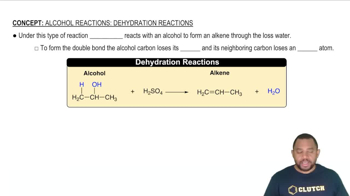
Alcohol Reactions: Dehydration Reactions