

Ch.4 - Reactions in Aqueous Solution
McMurry - Chemistry 8th Edition
McMurry8th EditionChemistryISBN: 9781292336145Not the one you use?Change textbook
Chapter 4, Problem 147

A mixture of FeCl2 and NaCl is dissolved in water, and addi-tion of aqueous silver nitrate then yields 7.0149 g of a pre-cipitate. When an identical amount of the mixture is titrated with MnO4 -, 14.28 mL of 0.198 M KMnO4 is needed for complete reaction. What are the mass percents of the two compounds in the mixture? (Na+ and Cl-do not react with MnO4 -. The equation for the reaction of Fe2+ with MnO4 was given in Problem 4.146.)

Verified step by step guidance
1
Identify the reactions involved: FeCl_2 reacts with AgNO_3 to form AgCl precipitate, and Fe^{2+} reacts with MnO_4^- in an oxidation-reduction reaction.
Calculate the moles of AgCl precipitate formed using its molar mass and the given mass of the precipitate.
Use stoichiometry to determine the moles of FeCl_2 in the mixture based on the moles of AgCl, since each mole of FeCl_2 produces one mole of AgCl.
Calculate the moles of KMnO_4 used in the titration from its volume and molarity, and use the stoichiometry of the redox reaction to find the moles of Fe^{2+} in the mixture.
Determine the mass of FeCl_2 and NaCl in the mixture using the moles of FeCl_2 and the total mass of the mixture, then calculate the mass percent of each compound.

Verified video answer for a similar problem:

This video solution was recommended by our tutors as helpful for the problem above.
Video duration:
3m
Was this helpful?

Key Concepts

Here are the essential concepts you must grasp in order to answer the question correctly.

Stoichiometry

Stoichiometry is the calculation of reactants and products in chemical reactions. It involves using balanced chemical equations to determine the relationships between the amounts of substances consumed and produced. In this question, stoichiometry is essential for relating the mass of precipitate formed from the reaction with silver nitrate to the amounts of FeCl2 and NaCl in the mixture.
Recommended video:
Guided course
01:16
Stoichiometry Concept

Precipitation Reactions

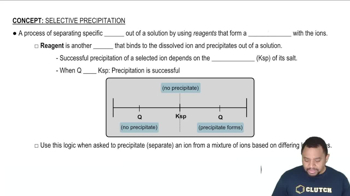
Precipitation reactions occur when two soluble salts react in solution to form an insoluble product, known as a precipitate. In this case, the addition of silver nitrate to the mixture results in the formation of silver chloride (AgCl), which precipitates out of the solution. Understanding the solubility rules and the specific reactions involved is crucial for determining the mass of the precipitate and the composition of the original mixture.
Recommended video:
Guided course
01:53
Selective Precipitation

Redox Reactions

Redox (reduction-oxidation) reactions involve the transfer of electrons between species, leading to changes in oxidation states. In this problem, the titration with KMnO4 involves the oxidation of Fe2+ ions to Fe3+, which is a key step in determining the amount of FeCl2 present in the mixture. Recognizing the role of MnO4- as an oxidizing agent is vital for calculating the mass percent of FeCl2 in the original sample.
Related Practice
Textbook Question
Iron content in ores can be determined by a redox procedure in which the sample is first reduced with Sn2+, as in Problem 4.130, and then titrated with KMnO4 to oxidize the Fe2+ to Fe3+. The balanced equation is What is the mass percent Fe in a 2.368 g sample if 48.39 mL of a 0.1116 M KMnO4 solution is needed to titrate the Fe3 + ?
306
views
Textbook Question
Salicylic acid, used in the manufacture of aspirin, contains only the elements C, H, and O and has only one acidic hydrogen that reacts with NaOH. When 1.00 g of salicylic acid undergoes complete combustion, 2.23 g CO2 and 0.39 g H2O are obtained. When 1.00 g of salicylic acid is titrated with 0.100 M NaOH, 72.4 mL of base is needed for complete reaction. What are the empirical and molecular formulas of salicylic acid?
1105
views
Textbook Question

Compound X contains only the elements C, H, O, and S. A 5.00 g sample undergoes complete combustion to give 4.83 g of CO2, 1.48 g of H2O, and a certain amount of SO2 that is further oxidized to SO3 and dissolved in water to form sulfuric acid, H2SO4. On titration of the H2SO4, 109.8 mL of 1.00 M NaOH is needed for complete reaction. (Both H atoms in sulfuric acid are acidic and react with NaOH.) (a) What is the empirical formula of X?

628
views
Textbook Question
A sample of metal (M) reacted with both steam and aqueous HCl to release H2 but did not react with water at room tem-perature. When 1.000 g of the metal was burned in oxygen, it formed 1.890 g of a metal oxide, M2O3. What is the iden-tity of the metal?
600
views
Textbook Question

A 1.268 g sample of a metal carbonate (MCO3) was treated with 100.00 mL of 0.1083 M sulfuric acid (H2SO4), yielding CO2 gas and an aqueous solution of the metal sulfate (MSO4). The solution was boiled to remove all the dissolved CO2 and was then titrated with 0.1241 M NaOH. A 71.02 mL volume of NaOH was required to neutralize the excess H2SO4. (a) What is the identity of the metal M?

524
views
Textbook Question
A mixture of acetic acid (CH3CO2H; monoprotic) and oxalic acid (H2C2O4; diprotic) requires 27.15 mL of 0.100 M NaOH to neutralize it. When an identical amount of the mixture is titrated, 15.05 mL of 0.0247 M KMnO4 is needed for complete reaction. What is the mass percent of each acid in the mixture? (Acetic acid does not react with MnO4 equation for the reaction of oxalic acid with MnO4 given in Problem 4.133.)
1110
views