Ch.4 - Reactions in Aqueous Solution
McMurry - Chemistry 8th Edition
McMurry8th EditionChemistryISBN: 9781292336145Not the one you use?Change textbook
Chapter 4, Problem 38

Assume that an aqueous solution of a cation, represented as a red sphere, is allowed to mix with a solution of an anion, represented as a yellow sphere. Three possible outcomes are represented by boxes (1)–(3): Two boxes showing blue spheres for cations and green spheres for anions in aqueous solutions.
Which outcome corresponds to each of the following reactions?(a) 2 Na+(aq) + CO32-(aq) S(b) Ba2+(aq) + CrO42-(aq) S(c) 2 Ag+(aq) + SO32-(aq) S

Verified step by step guidance
1
Identify the cations and anions in each reaction: Na+, CO32-, Ba2+, CrO42-, Ag+, SO32-.
Determine the solubility rules to predict if a precipitate will form for each reaction.
For reaction (a) 2 Na+(aq) + CO32-(aq), check if Na2CO3 is soluble or forms a precipitate.
For reaction (b) Ba2+(aq) + CrO42-(aq), check if BaCrO4 is soluble or forms a precipitate.
For reaction (c) 2 Ag+(aq) + SO32-(aq), check if Ag2SO3 is soluble or forms a precipitate.

Key Concepts

Here are the essential concepts you must grasp in order to answer the question correctly.

Ionic Compounds and Precipitation Reactions

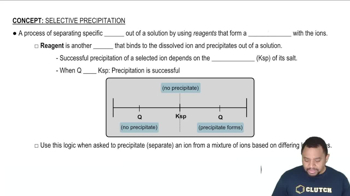
Ionic compounds are formed from the electrostatic attraction between cations and anions. In aqueous solutions, certain combinations of ions can lead to precipitation reactions, where insoluble ionic compounds form and separate from the solution. Understanding the solubility rules helps predict whether a precipitate will form when two ionic solutions are mixed.
Recommended video:
Guided course
01:53
Selective Precipitation

Solubility Rules

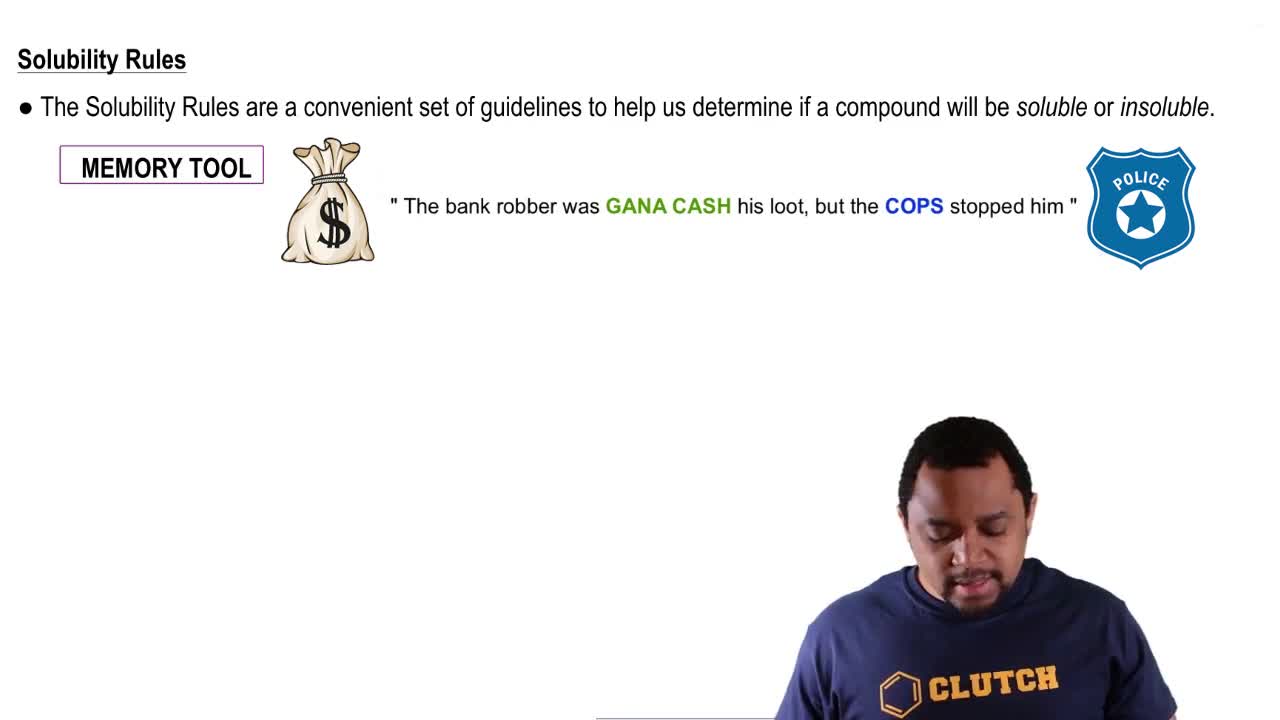
Solubility rules are guidelines that help predict the solubility of ionic compounds in water. For example, most alkali metal salts and nitrates are soluble, while many sulfates and carbonates are not. These rules are essential for determining the outcomes of reactions involving ionic compounds, particularly in predicting which combinations will yield a solid precipitate.
Recommended video:
Guided course
00:28
Solubility Rules

Chemical Equation Representation

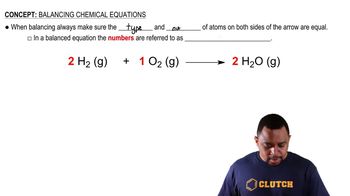
Chemical equations represent the reactants and products in a chemical reaction. In the context of precipitation reactions, the equations show the ions involved and the resulting solid. Understanding how to balance these equations and identify the states of matter (solid, liquid, gas, aqueous) is crucial for accurately describing the outcomes of the reactions presented in the question.
Recommended video:
Guided course
01:32
Balancing Chemical Equations
Related Practice
Textbook Question
The most strongly reducing elements are listed at the top of the partial activity series table provided. Use the activity series to predict which reaction will occur. (LO 4.20) (a) (b) (c) (d)

275
views

Textbook Question
Assume that an aqueous solution of OH-, represented as a blue sphere, is allowed to mix with a solution of an acid HnA, represented as a red sphere. Three possible outcomes are depicted by boxes (1)–(3), where the green spheres represent An-, the anion of the acid: Which outcome corresponds to each of the following reactions? (a) (b) (c)
540
views
Textbook Question
The concentration of an aqueous solution of NaOCl (sodium hypochlorite; the active ingredient in household bleach) can be determined by a redox titration with iodide ion in acidic solution:

Assume that the blue spheres in the buret represent I-ions, the red spheres in the flask represent OCl-ions, the con-centration of the I-ions in the buret is 0.120 M, and the volumes in the buret and the flask are identical. What is the concentration of NaOCl in the flask? What percentage of the I-solution in the buret must be added to the flask to react with all the OCl-ions?

1051
views
Textbook Question

Box (a) represents 1.0 mL of a solution of particles at a given concentration. Which of the boxes (b)–(d) represents 1.0 mL of the solution that results after (a) has been diluted by doubling the volume of its solvent? (a)

(b)

(c)

(d)

399
views
Textbook Question

Classify each of the following unbalanced half-reactions as either an oxidation or a reduction. (a) HClO(aq) → Cl2(g)

507
views
Textbook Question
Identify the element that gets oxidized and the oxidizing agent in the reaction. (LO 4.19) (a) (b) (c) (d)
387
views