

Ch.4 - Reactions in Aqueous Solution
McMurry - Chemistry 8th Edition
McMurry8th EditionChemistryISBN: 9781292336145Not the one you use?Change textbook
Chapter 4, Problem 133

Calcium levels in blood can be determined by adding oxa-late ion to precipitate calcium oxalate, CaC2O4, followed by dissolving the precipitate in aqueous acid and titrating the resulting oxalic acid (H2C2O4) with KMnO4: How many milligrams of Ca2+ are present in 10.0 mL of blood if 21.08 mL of 0.000 988 M KMnO4 solution is needed for the titration?

Verified step by step guidance
1
Determine the moles of KMnO_4 used in the titration by multiplying the volume of KMnO_4 solution (in liters) by its molarity.
Write the balanced chemical equation for the reaction between KMnO_4 and H_2C_2O_4. Use this equation to find the stoichiometric ratio between KMnO_4 and H_2C_2O_4.
Calculate the moles of H_2C_2O_4 that reacted using the stoichiometric ratio from the balanced equation.
Since the moles of H_2C_2O_4 are equal to the moles of CaC_2O_4, determine the moles of Ca^2+ present, as each mole of CaC_2O_4 contains one mole of Ca^2+.
Convert the moles of Ca^2+ to milligrams using the molar mass of calcium (Ca).

Key Concepts

Here are the essential concepts you must grasp in order to answer the question correctly.

Precipitation Reactions

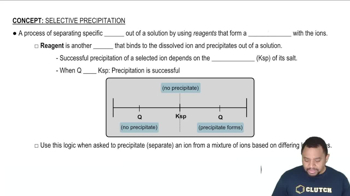
Precipitation reactions occur when two soluble reactants form an insoluble product, or precipitate. In this case, calcium ions (Ca2+) react with oxalate ions (C2O4^2-) to form calcium oxalate (CaC2O4), which can be separated from the solution. Understanding this concept is crucial for determining the amount of calcium in the blood, as it sets the stage for subsequent analysis.
Recommended video:
Guided course
01:53
Selective Precipitation

Titration

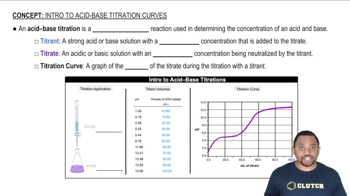
Titration is a quantitative analytical technique used to determine the concentration of a solute in a solution. In this scenario, the oxalic acid produced from the dissolved calcium oxalate is titrated with a potassium permanganate (KMnO4) solution. The endpoint of the titration indicates that all the oxalic acid has reacted, allowing for the calculation of the original calcium concentration based on the volume and molarity of the KMnO4 used.
Recommended video:
Guided course
03:04
Acid-Base Titration

Stoichiometry

Stoichiometry involves the calculation of reactants and products in chemical reactions based on balanced equations. In this problem, stoichiometry is essential for relating the amount of KMnO4 used in the titration to the amount of oxalic acid produced, and subsequently to the amount of calcium ions in the original blood sample. This allows for the conversion of titration data into a meaningful measurement of calcium concentration.
Recommended video:
Guided course
01:16
Stoichiometry Concept
Related Practice
Textbook Question
Standardized solutions of KBrO3 are frequently used in redox titrations. The necessary solution can be made by dissolving KBrO3 in water and then titrating it with an As(III) solution. What is the molar concentration of a KBrO3 solution if 28.55 mL of the solution is needed to titrate 1.550 g of As2O3? See Problem 4.128 for the balanced equation. (As2O3 dissolves in aqueous acid solution to yield H3AsO3: As2O3 + 3 H2OS 2 H3AsO3.)
976
views
Textbook Question
The concentration of the Sn2+ solution used in Problem 4.130 can be found by letting it react with a known amount of Fe2+. What is the molar concentration of an Sn2+ solution if 23.84 mL is required for complete reaction with 1.4855 g of Fe2O3?
472
views
Textbook Question

A compound with the formula XOCl2 reacts with water, yielding HCl and another acid H2XO3, which has two acidic hydrogens that react with NaOH. When 0.350 g of XOCl2 was added to 50.0 mL of water and the resultant solution was titrated, 96.1 mL of 0.1225 M NaOH was required to react with all the acid. (b) What are the atomic mass and identity of element X?

431
views
Textbook Question

A compound with the formula XOCl2 reacts with water, yielding HCl and another acid H2XO3, which has two acidic hydrogens that react with NaOH. When 0.350 g of XOCl2 was added to 50.0 mL of water and the resultant solution was titrated, 96.1 mL of 0.1225 M NaOH was required to react with all the acid. (a) Write a balanced equation for the reaction of XOCl2 with H2O.

526
views
Textbook Question
Alcohol levels in blood can be determined by a redox reaction with potassium dichromate according to the balanced equation What is the blood alcohol level in mass percent if 8.76 mL of 0.049 88 M K2Cr2O7 is required for complete reaction with a 10.002 g sample of blood?
726
views
Textbook Question
A procedure for determining the amount of iron in a sample is to convert the iron to Fe2+ and then titrate it with a solu-tion of Ce(NH4)2(NO3)6: What is the mass percent of iron in a sample if 1.2284 g of the sample requires 54.91 mL of 0.1018 M Ce(NH4)2(NO3)6 for complete reaction?
650
views