Ch.4 - Reactions in Aqueous Solution
McMurry - Chemistry 8th Edition
McMurry8th EditionChemistryISBN: 9781292336145Not the one you use?Change textbook
Chapter 4, Problem 46a

How many moles of solute are present in each of the following solutions? (a) 35.0 mL of 1.200 M HNO3

Verified step by step guidance
1
Determine the formula for calculating moles from molarity and volume: \( \text{moles} = \text{molarity} \times \text{volume in liters} \).
Convert the volume from milliliters to liters: \( 35.0 \text{ mL} = 0.0350 \text{ L} \).
Substitute the given values into the formula: \( \text{moles} = 1.200 \text{ M} \times 0.0350 \text{ L} \).
Perform the multiplication to find the number of moles.
Ensure the units are consistent and the calculation is correct.

Verified video answer for a similar problem:

This video solution was recommended by our tutors as helpful for the problem above.
Video duration:
51s
Was this helpful?

Key Concepts

Here are the essential concepts you must grasp in order to answer the question correctly.

Molarity (M)

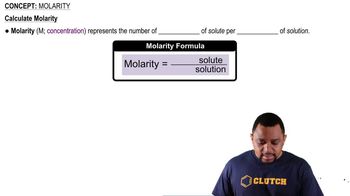
Molarity is a measure of concentration defined as the number of moles of solute per liter of solution. It is expressed in moles per liter (mol/L). Understanding molarity is crucial for calculating the amount of solute in a given volume of solution, as it directly relates the volume of the solution to the number of moles present.
Recommended video:
Guided course
00:53
Molarity Concept

Volume Conversion

In chemistry, it is often necessary to convert volumes from milliliters (mL) to liters (L) when working with molarity. Since 1 L equals 1000 mL, converting mL to L involves dividing the volume in mL by 1000. This conversion is essential for accurately applying the molarity formula to determine the number of moles of solute.

Calculating Moles from Molarity

To find the number of moles of solute in a solution, the formula used is: moles = molarity × volume (in liters). This relationship allows for the straightforward calculation of moles when both the molarity and the volume of the solution are known. It is a fundamental concept in stoichiometry and solution chemistry.
Recommended video:
Guided course
03:12
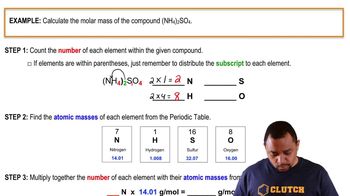
Molar Mass Calculation Example