

Draw orbital-filling diagrams for atoms with the following atomic numbers. Show each electron as an up or down arrow, and use the abbreviation of the preceding noble gas to represent inner-shell electrons. (a) Z = 25 (b) Z = 56 (c) Z = 28 (d) Z = 47
Ch.5 - Periodicity & Electronic Structure of Atoms
Chapter 5, Problem 108
How many unpaired electrons are present in each of the following ground-state atoms?(a) O (b) Si (c) K (d) As
Verified step by step guidance1
Determine the electron configuration for each atom in its ground state.
For oxygen (O), with atomic number 8, the electron configuration is 1s^2 2s^2 2p^4.
For silicon (Si), with atomic number 14, the electron configuration is 1s^2 2s^2 2p^6 3s^2 3p^2.
For potassium (K), with atomic number 19, the electron configuration is 1s^2 2s^2 2p^6 3s^2 3p^6 4s^1.
For arsenic (As), with atomic number 33, the electron configuration is 1s^2 2s^2 2p^6 3s^2 3p^6 3d^10 4s^2 4p^3.

Verified video answer for a similar problem:
This video solution was recommended by our tutors as helpful for the problem above.
Video duration:
3mWas this helpful?
Key Concepts
Here are the essential concepts you must grasp in order to answer the question correctly.
Electron Configuration
Electron configuration describes the distribution of electrons in an atom's orbitals. It follows the Aufbau principle, which states that electrons fill the lowest energy orbitals first. Understanding the electron configuration of an atom is essential for determining the number of unpaired electrons, as it reveals how electrons are arranged in subshells.
Recommended video:
Guided course
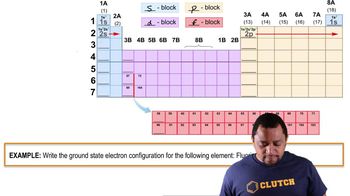
Electron Configuration Example
Pauli Exclusion Principle
The Pauli Exclusion Principle states that no two electrons in an atom can have the same set of quantum numbers. This principle leads to the concept of paired and unpaired electrons, where paired electrons occupy the same orbital with opposite spins, while unpaired electrons exist in orbitals alone. This principle is crucial for identifying unpaired electrons in an atom's ground state.
Recommended video:
Guided course
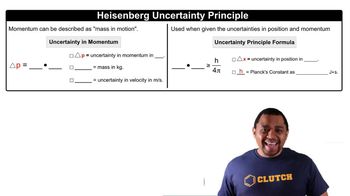
Uncertainty Principle Formula
Hund's Rule
Hund's Rule states that electrons will occupy degenerate orbitals singly before pairing up. This means that when filling orbitals of the same energy level, each orbital gets one electron first, which helps maximize the number of unpaired electrons. Understanding this rule is vital for accurately determining the number of unpaired electrons in an atom's ground state.
Recommended video:
Guided course
Solubility Rules
Related Practice
Textbook Question
902
views
Textbook Question
Write the symbol, give the ground-state electron configuration, and draw an orbital-filling diagram for each of the following atoms. Use the abbreviation of the preceding noble gas to represent the inner-shell electrons. (a) The heaviest alkaline earth metal
727
views
Textbook Question
Write the symbol, give the ground-state electron configuration, and draw an orbital-filling diagram for each of the following atoms. Use the abbreviation of the preceding noble gas to represent the inner-shell electrons.
(c) The heaviest actinide metal
820
views
Textbook Question
Give the expected ground-state electron configurations for atoms with the following atomic numbers. (a) Z = 55 (b) Z = 40 (c) Z = 80 (d) Z = 62
613
views
