Ch.7 - Covalent Bonding and Electron-Dot Structures
McMurry - Chemistry 8th Edition
McMurry8th EditionChemistryISBN: 9781292336145Not the one you use?Change textbook
Chapter 7, Problem 85d

Draw as many resonance structures as you can for the following nitrogen-containing compounds. Not all will obey the octet rule. Use curved arrows to depict the conversion of one structure into another. (d) N2O3(ONNO2)

Verified step by step guidance
1
Identify the Lewis structure of N2O3. Start by arranging the atoms where nitrogen and oxygen are bonded in a way that satisfies the typical valences (N typically forms three bonds, O typically forms two bonds).
Determine the formal charges on each atom in the initial structure to ensure the most stable arrangement of electrons. Remember that the sum of the formal charges should equal the overall charge of the molecule (which is neutral in this case).
Use curved arrows to show the movement of electrons to form different resonance structures. Move electrons from areas of higher electron density (like lone pairs or double bonds) to adjacent atoms or bonds that can accept electrons.
Create additional resonance structures by changing the locations of double bonds and lone pairs while keeping the connectivity of the atoms the same. Ensure that each structure still follows the rules of chemical bonding, although not all structures may obey the octet rule.
Review all the drawn resonance structures to ensure they are valid. Each structure should have atoms with complete valence shells where possible, except where the octet rule is not obeyed, and formal charges should be minimized.

Key Concepts

Here are the essential concepts you must grasp in order to answer the question correctly.

Resonance Structures

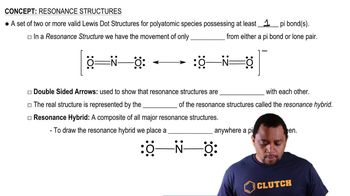
Resonance structures are different ways of drawing the same molecule that illustrate the delocalization of electrons. They are used to represent molecules where a single Lewis structure cannot adequately depict the electron distribution. Each resonance structure contributes to the overall hybrid structure, which is a more accurate representation of the molecule's actual electron configuration.
Recommended video:
Guided course
01:42
Resonance Structures

Octet Rule

The octet rule is a chemical guideline stating that atoms tend to bond in such a way that they each have eight electrons in their valence shell, achieving a stable electron configuration similar to that of noble gases. While many elements follow this rule, some, particularly transition metals and heavier elements, can have expanded octets or may not complete their octet, leading to exceptions in resonance structures.

Curved Arrows in Resonance

Curved arrows are a notation used in organic chemistry to show the movement of electrons during the formation of resonance structures. The tail of the arrow indicates the starting point of the electron pair, while the head points to where the electrons are moving. This visual representation helps in understanding how different resonance forms are interrelated and how electron delocalization occurs within a molecule.
Recommended video:
Guided course
01:42
Resonance Structures