Ch.7 - Covalent Bonding and Electron-Dot Structures
McMurry - Chemistry 8th Edition
McMurry8th EditionChemistryISBN: 9781292336145Not the one you use?Change textbook
Chapter 7, Problem 34

Electrostatic potential maps of acetaldehyde (C2H4), ethane (C2H6), ethanol (C2H6O), and fluorethane (C2H5F) are shown. Which do you think is which? (a)
Electrostatic potential map of acetaldehyde, ethane, ethanol, and fluorethane for identification.
(b)
(c)
(d)

Verified step by step guidance
1
Identify the molecules: acetaldehyde (C2H4O), ethane (C2H6), ethanol (C2H6O), and fluoroethane (C2H5F).
Understand that the electrostatic potential map shows regions of electron density, with red indicating regions of high electron density (negative potential) and blue indicating regions of low electron density (positive potential).
Analyze the given electrostatic potential map: the red region suggests a highly electronegative atom or group.
Compare the structures of the molecules: acetaldehyde has a carbonyl group (C=O), ethanol has a hydroxyl group (OH), fluoroethane has a fluorine atom (F), and ethane is a simple hydrocarbon with no highly electronegative atoms.
Determine which molecule corresponds to the given map by matching the regions of high electron density (red) to the presence of electronegative atoms or groups in the molecular structures.

Verified video answer for a similar problem:

This video solution was recommended by our tutors as helpful for the problem above.
Video duration:
3m
Was this helpful?

Key Concepts

Here are the essential concepts you must grasp in order to answer the question correctly.

Electrostatic Potential Maps

Electrostatic potential maps visually represent the distribution of electron density in a molecule. Areas of high electron density appear in red, indicating regions of negative charge, while blue areas represent low electron density or positive charge. These maps help in understanding molecular polarity and reactivity, which are crucial for predicting how molecules will interact with each other.
Recommended video:
Guided course
00:34
Kinetic & Potential Energy

Molecular Structure and Functional Groups

The molecular structure of compounds, including their functional groups, significantly influences their chemical properties and behavior. For instance, acetaldehyde contains a carbonyl group, while ethanol has a hydroxyl group. Recognizing these functional groups allows for the identification of molecules based on their electrostatic potential maps, as different groups will affect electron distribution differently.

Polarity and Intermolecular Forces

Polarity arises from the uneven distribution of electron density within a molecule, leading to partial positive and negative charges. This polarity affects intermolecular forces such as hydrogen bonding, dipole-dipole interactions, and London dispersion forces. Understanding these concepts is essential for predicting the physical properties of substances, such as boiling points and solubility, which can be inferred from their electrostatic potential maps.
Recommended video:
Guided course
01:59
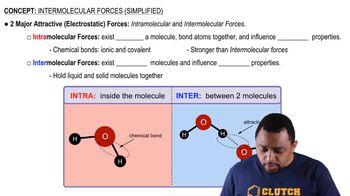
Intermolecular vs Intramolecular Forces
Related Practice
Textbook Question
Match the following descriptions with the type of bond (ionic, nonpolar covalent, covalent). (a) One or more electrons are transferred from a metal to a nonmetal atom.
923
views

Textbook Question
Which is the best electron-dot structure for the thiosulfate ion (S2O3 2-) based on the rules of formal charge? (LO 7.16)(a) (b) (c) (d)
576
views
Textbook Question
Why do two atoms come together to form a covalent bond?(a) Attractive forces between the positively charged nuclei and the electrons in both atoms occur when the atoms are close together.(b) Repulsive forces between protons in the nuclei of the two atoms are minimized when the atoms are close together.(c) Repulsive forces between electrons in the two atoms are minimized when the atoms are close together.
953
views
Textbook Question

Use formal charge to select which resonance structure makes the largest contribution to the resonance hybrid. (LO 7.16) (a) Structure I (b) Structure II (c) Structure III (d) All structures are equivalent and make the same contri-bution to the resonance hybrid. (I)

(II)

(III)

606
views
Textbook Question
What is the best prediction for the carbon–oxygen bond length in the carbonate anion, CO3 2-? (LO 7.14)Data for average carbon-oxygen bond lengths: (a) 143 pm (b) 132 pm(c) 121 pm(d) 118 pm
736
views
Textbook Question
The following ball-and-stick molecular model is a representation of thalidomide, a drug that causes birth defects when taken by expectant mothers but is valuable for its use against leprosy. The lines indicate only the connections between atoms, not whether the bonds are single, double, or triple. (Red = O, gray = C, blue = N, ivory = H). Give the formula of thalidomide, and indicate the positions of multiple bonds and lone pairs.

667
views