Ch.7 - Covalent Bonding and Electron-Dot Structures
McMurry - Chemistry 8th Edition
McMurry8th EditionChemistryISBN: 9781292336145Not the one you use?Change textbook
Chapter 7, Problem 93

Four different structures (a), (b), (c), and (d) can be drawn for compounds named dibromobenzene, but only three different compounds actually exist. Explain.(a) Resonance structure (a) of dibromobenzene showing bromine atoms in one position.
(b) Resonance structure (b) of dibromobenzene with bromine atoms in a different position.
(c) Resonance structure (c) of dibromobenzene illustrating another arrangement of bromine atoms.
(d) Resonance structure (d) of dibromobenzene depicting a fourth arrangement of bromine atoms.

Verified step by step guidance
1
Identify the positions of the bromine atoms in each of the four structures (a), (b), (c), and (d).
Recognize that the benzene ring has six carbon atoms, and the positions of the substituents can be described as ortho (adjacent), meta (one carbon apart), or para (opposite).
Determine the relative positions of the bromine atoms in each structure: (a) ortho, (b) meta, (c) meta, and (d) para.
Notice that structures (b) and (c) are actually the same compound because they both have bromine atoms in the meta positions, making them indistinguishable from each other.
Conclude that only three distinct compounds exist: ortho-dibromobenzene, meta-dibromobenzene, and para-dibromobenzene.

Verified video answer for a similar problem:

This video solution was recommended by our tutors as helpful for the problem above.
Video duration:
1m
Was this helpful?

Key Concepts

Here are the essential concepts you must grasp in order to answer the question correctly.

Isomerism

Isomerism refers to the phenomenon where two or more compounds have the same molecular formula but different structural arrangements. In the case of dibromobenzene, the different positions of the bromine atoms on the benzene ring lead to distinct isomers, which can exhibit different physical and chemical properties.
Recommended video:
Guided course
2:14
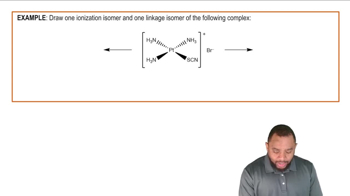
Isomerism in Coordination Complexes Example

Symmetry and Chirality

Symmetry plays a crucial role in determining the existence of distinct compounds. In dibromobenzene, certain arrangements of bromine atoms may lead to symmetrical structures that are indistinguishable from one another, resulting in fewer unique compounds than the number of possible structures. Chirality, or lack thereof, can also influence the number of isomers.
Recommended video:

Resonance Structures

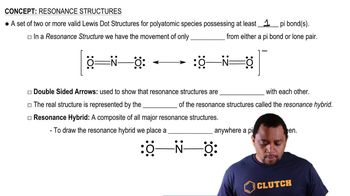
Resonance structures are different ways of representing the same molecule, where the actual structure is a hybrid of these forms. For dibromobenzene, while multiple resonance structures can be drawn, they may not correspond to unique compounds if they represent the same arrangement of atoms. Understanding resonance helps clarify why only three distinct compounds exist despite four possible structures.
Recommended video:
Guided course
01:42
Resonance Structures