Ch.9 - Thermochemistry: Chemical Energy
McMurry - Chemistry 8th Edition
McMurry8th EditionChemistryISBN: 9781292336145Not the one you use?Change textbook
Chapter 9, Problem 50

Calculate the work done in joules by a chemical reaction if the volume increases from 3.2 L to 3.4 L against a constant external pressure of 3.6 atm. What is the sign of the energy change?

Verified step by step guidance
1
First, we need to understand that the work done by a system in a process that is carried out at constant pressure is given by the equation: W = -PΔV. Here, W is the work done, P is the pressure, and ΔV is the change in volume. The negative sign indicates that work is done by the system on its surroundings.
Next, we need to convert the pressure from atmospheres to pascals because the standard unit of pressure in the International System of Units (SI) is the pascal (Pa). We can do this by using the conversion factor 1 atm = 101325 Pa. So, the pressure in pascals is 3.6 atm * 101325 Pa/atm.
Then, we need to convert the volume from liters to cubic meters because the standard unit of volume in the SI is the cubic meter (m^3). We can do this by using the conversion factor 1 L = 0.001 m^3. So, the initial volume in cubic meters is 3.2 L * 0.001 m^3/L and the final volume in cubic meters is 3.4 L * 0.001 m^3/L.
Now, we can calculate the change in volume, ΔV, which is the final volume minus the initial volume.
Finally, we can substitute the values of P and ΔV into the equation W = -PΔV to calculate the work done by the system. The sign of the energy change will be negative if work is done by the system, indicating that energy is transferred from the system to its surroundings.

Verified video answer for a similar problem:

This video solution was recommended by our tutors as helpful for the problem above.
Video duration:
3m
Was this helpful?

Key Concepts

Here are the essential concepts you must grasp in order to answer the question correctly.

Work in Thermodynamics

In thermodynamics, work is defined as the energy transferred when a force is applied over a distance. For chemical reactions occurring at constant pressure, the work done by the system can be calculated using the formula W = -P_ext ΔV, where P_ext is the external pressure and ΔV is the change in volume. A positive change in volume indicates that the system is doing work on the surroundings.
Recommended video:
Guided course
01:18
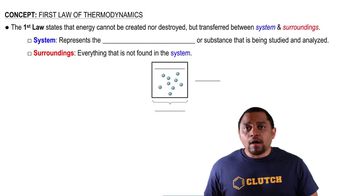
First Law of Thermodynamics

Pressure-Volume Work

Pressure-volume work occurs when a gas expands or contracts against an external pressure. The work done by the system is negative when the system expands (volume increases), as it requires energy to push against the external pressure. Conversely, if the volume decreases, the work is positive, indicating that the surroundings are doing work on the system.
Recommended video:
Guided course
02:35
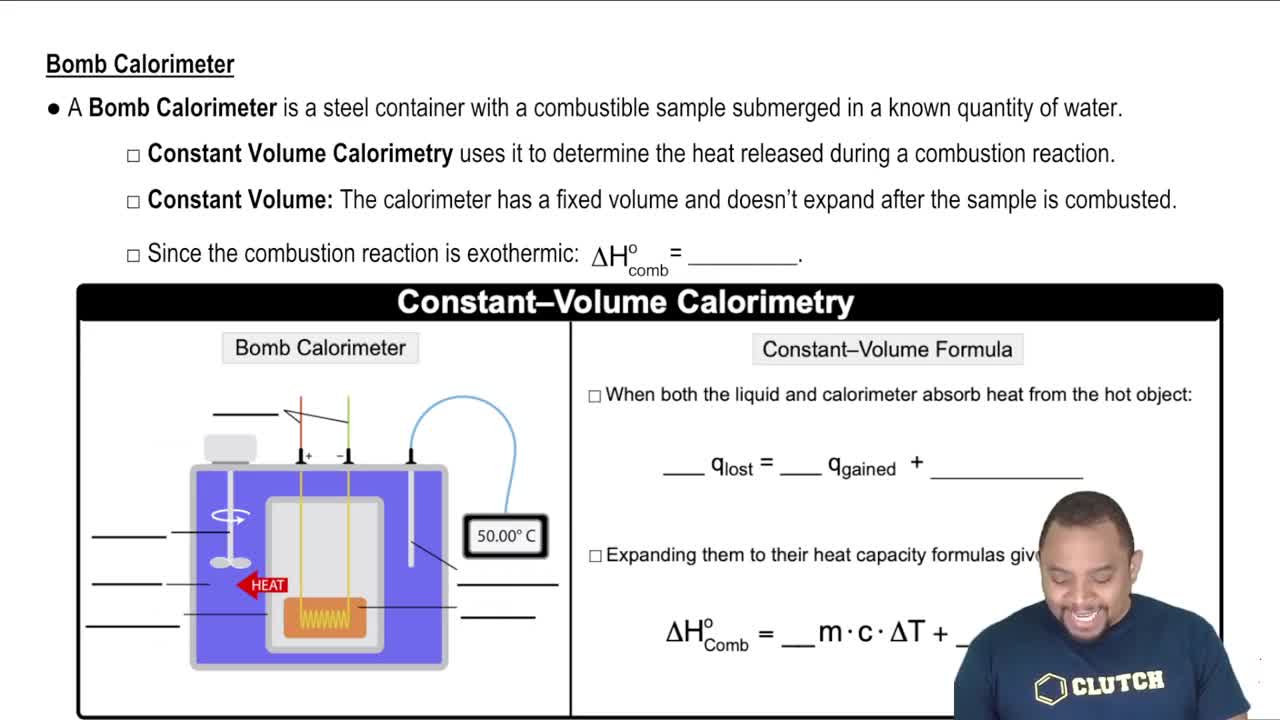
Constant-Volume Calorimetry

Sign of Energy Change

The sign of the energy change in a chemical reaction is determined by the direction of energy flow. If the system does work on the surroundings (expansion), the energy change is negative, indicating a loss of energy from the system. Conversely, if the surroundings do work on the system (compression), the energy change is positive, reflecting an energy gain by the system.
Recommended video:
Guided course
01:53
Chemical Changes