

Ch.9 - Thermochemistry: Chemical Energy
McMurry - Chemistry 8th Edition
McMurry8th EditionChemistryISBN: 9781292336145Not the one you use?Change textbook
Chapter 9, Problem 97

Set up a Hess's law cycle, and use the following information to calculate ΔH°f for aqueous nitiric acid, HNO3(aq). You will need to use fractional coefficients for some equations. 3 NO2(g) + H2O(l) → 2 HNO3(aq) + NO(g) ΔH° = -137.3 kJ 2 NO(g) + O2(g) → 2 NO2(g) ΔH° = -116.2 kJ 4 NH3(g) + 5 O2(g) → 4 NO (g) + 6 H2O(l) ΔH° = -1165.2 kJ NH3(g) ΔH°f = -46.1 kJ/mol H2O(l) ΔH°f = -285.8 kJ/mol

Verified step by step guidance
1
Identify the target reaction for which you need to find the standard enthalpy of formation (ΔH°f) of HNO3(aq). This is the formation of HNO3(aq) from its elements in their standard states: 1/2 N2(g) + 1/2 O2(g) + 1/2 H2(g) → HNO3(aq).
Write the given reactions and their enthalpy changes: (1) 3 NO2(g) + H2O(l) → 2 HNO3(aq) + NO(g) ΔH° = -137.3 kJ, (2) 2 NO(g) + O2(g) → 2 NO2(g) ΔH° = -116.2 kJ, (3) 4 NH3(g) + 5 O2(g) → 4 NO(g) + 6 H2O(l) ΔH° = -1165.2 kJ.
Use the enthalpy of formation values for NH3(g) and H2O(l) to express their formation reactions: NH3(g) → 1/2 N2(g) + 3/2 H2(g) ΔH°f = 46.1 kJ/mol, H2O(l) → H2(g) + 1/2 O2(g) ΔH°f = 285.8 kJ/mol.
Reverse and adjust the given reactions as needed to form a Hess's law cycle that starts from the elements in their standard states and ends with the formation of HNO3(aq). This may involve reversing reactions and changing their ΔH° signs.
Add the adjusted reactions together, ensuring that all intermediate species cancel out, leaving only the formation of HNO3(aq) from its elements. Sum the enthalpy changes to find ΔH°f for HNO3(aq).

Verified video answer for a similar problem:

This video solution was recommended by our tutors as helpful for the problem above.
Video duration:
2m
Was this helpful?

Key Concepts

Here are the essential concepts you must grasp in order to answer the question correctly.

Hess's Law

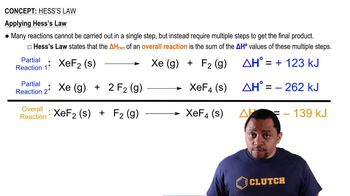
Hess's Law states that the total enthalpy change for a chemical reaction is the same, regardless of the number of steps taken to complete the reaction. This principle allows us to calculate the enthalpy change of a reaction by summing the enthalpy changes of individual steps, making it particularly useful for reactions that cannot be measured directly.
Recommended video:

Standard Enthalpy of Formation (ΔH°f)

The standard enthalpy of formation (ΔH°f) is the change in enthalpy when one mole of a compound is formed from its elements in their standard states. This value is crucial for calculating the enthalpy changes in reactions, as it provides a reference point for the stability of compounds and their formation from elemental forms.

Fractional Coefficients in Reactions

Using fractional coefficients in chemical equations allows for the accurate representation of stoichiometry when balancing reactions, especially in Hess's Law calculations. This approach is necessary when the stoichiometric ratios do not yield whole numbers, ensuring that the enthalpy changes can be correctly scaled to match the desired reaction.
Recommended video:
Guided course
00:36
Mole Fraction Formula
Related Practice
Textbook Question
The following steps occur in the reaction of ethyl alcohol (CH3CH2OH) wiht oxygen to yield acetic acid (CH3CO2H). Show that equations 1 and 2 sum to give the net equation and calculate ΔH° for the net equation. (1) CH3CH2OH(l) + 1/2 O2(g) → CH3CHO (g) + H2O(l) ΔH° = -174.2 kJ (2) CH3CHO(g) + 1/2 O2(g) → CH3CO2H(l) ΔH° = -318.4 kJ (Net) CH3CH2OH(l) + O2(g) → CH3CO2H(l) + H2O(l) ΔH° = ?
685
views
Textbook Question
The industrial degreasing solvent methylene chloride, CH2Cl2, is prepared from methane by reaction with chlorine: CH4(g) + 2 Cl2(g) → CH2Cl2(g) + 2 HCl(g) Use the following data to calcualte ΔH° in kilojoules for the reaction: CH4(g) + Cl2(g) → CH3Cl(g) + HCl(g) ΔH° = -98.3 kJ CH3Cl(g) + Cl2(g) → CH2Cl2(g) + HCl(g) ΔH° = -104 kJ
710
views
Textbook Question
What is the phase of the standard states of the following ele- ments and compounds?(a) NH3 (b) Fe (c) N2 (d) Br2
388
views
Textbook Question
How is the standard state of an element defined? Why doelements always have ∆H°f = 0?
899
views
Textbook Question
What phase of matter is associated with the standard states of the following elements and compounds? (a) Cl2 (b) Hg (c) CO2 (d) Ga
493
views
Textbook Question
Hess's law can be used to calculate reaction enthalpies for hypothetical processes that can't be carried out in the labo- ratory. Set up a Hess's law cycle that will let you calculate ∆H° for the conversion of methane to ethylene: 2 CH4(g) → C2H4(g) + 2 H2(g) You can use the following information: 2 C2H6(g) + 7 O2(g) → 4 CO2(g) + 6 H2O(l) ∆H° = -3120.8 kJ CH4(g) + 2 O2(g) → CO2(g) + 2 H2O(l) ∆H° = -890.3 kJ C2H4(g) + H2(g) → C2H6(g) ∆H° = -136.3 kJ H2O(l) ∆H°f = -285.8 kJ/mol
1018
views