Ch.9 - Thermochemistry: Chemical Energy
McMurry - Chemistry 8th Edition
McMurry8th EditionChemistryISBN: 9781292336145Not the one you use?Change textbook
Chapter 9, Problem 133

Tell whether reactions with the following values of ΔH and ΔS are spontaneous or nonspontaneous and whether they are exothermic or endothermic. (a) ΔH = -128 kJ; ΔS = 35 J/K at 500 K (b) ΔH = +67 kJ; ΔS = -140 J/K at 250 K (c) ΔH = +75 kJ; ΔS = 95 J/K at 800 K

Verified step by step guidance
1
Step 1: Understand the relationship between spontaneity, enthalpy (ΔH), and entropy (ΔS) using the Gibbs free energy equation: ΔG = ΔH - TΔS, where T is the temperature in Kelvin.
Step 2: Convert the entropy change (ΔS) from J/K to kJ/K by dividing by 1000, since ΔH is given in kJ.
Step 3: Calculate the Gibbs free energy change (ΔG) for each reaction using the equation ΔG = ΔH - TΔS, substituting the given values for ΔH, ΔS, and T.
Step 4: Determine spontaneity: If ΔG < 0, the reaction is spontaneous; if ΔG > 0, the reaction is nonspontaneous.
Step 5: Determine if the reaction is exothermic or endothermic: If ΔH < 0, the reaction is exothermic; if ΔH > 0, the reaction is endothermic.

Key Concepts

Here are the essential concepts you must grasp in order to answer the question correctly.

Gibbs Free Energy

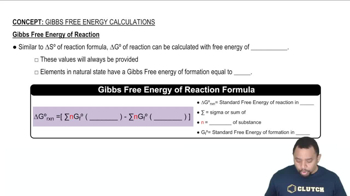
Gibbs Free Energy (G) is a thermodynamic potential that helps predict the spontaneity of a reaction at constant temperature and pressure. The change in Gibbs Free Energy (ΔG) is calculated using the equation ΔG = ΔH - TΔS, where ΔH is the change in enthalpy, T is the temperature in Kelvin, and ΔS is the change in entropy. A negative ΔG indicates a spontaneous reaction, while a positive ΔG suggests nonspontaneity.
Recommended video:
Guided course
01:51
Gibbs Free Energy of Reactions

Enthalpy (ΔH)

Enthalpy (ΔH) is a measure of the total heat content of a system. It indicates whether a reaction is exothermic (releases heat, ΔH < 0) or endothermic (absorbs heat, ΔH > 0). Understanding the sign of ΔH is crucial for determining the energy changes associated with a reaction and its impact on spontaneity when combined with entropy changes.
Recommended video:
Guided course
02:34
Enthalpy of Formation

Entropy (ΔS)

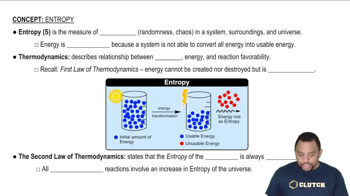
Entropy (ΔS) is a measure of the disorder or randomness in a system. A positive ΔS indicates an increase in disorder, which generally favors spontaneity, while a negative ΔS suggests a decrease in disorder. The relationship between entropy and temperature is essential for evaluating the overall spontaneity of a reaction, as it influences the Gibbs Free Energy calculation.
Recommended video:
Guided course
02:46
Entropy in Thermodynamics