Silver can be electroplated at the cathode of an electrolysis cell by the half-reaction: Ag+(aq) + e– → Ag(s) What mass of silver would plate onto the cathode if a current of 6.8 A flowed through the cell for 72 min?
Ch.19 - Electrochemistry
Chapter 19, Problem 97
Make a sketch of an electrolysis cell that electroplates copper onto other metal surfaces. Label the anode and the cathode and indicate the reactions that occur at each.
Verified step by step guidance1
Start by drawing a container to represent the electrolysis cell, which will hold the electrolyte solution.
Inside the container, draw two electrodes: one on the left side and one on the right side. Label the left electrode as the 'anode' and the right electrode as the 'cathode'.
Indicate that the anode is made of copper (Cu) and the cathode is the metal surface onto which copper will be electroplated.
Write the oxidation reaction occurring at the anode: Cu(s) \(\rightarrow\) Cu^{2+}(aq) + 2e^{-}. This shows that solid copper is oxidized to copper ions, releasing electrons.
Write the reduction reaction occurring at the cathode: Cu^{2+}(aq) + 2e^{-} \(\rightarrow\) Cu(s). This shows that copper ions in the solution gain electrons to form solid copper, which deposits onto the cathode.

Verified video answer for a similar problem:
This video solution was recommended by our tutors as helpful for the problem above.
Video duration:
3mWas this helpful?
Key Concepts
Here are the essential concepts you must grasp in order to answer the question correctly.
Electrolysis
Electrolysis is a chemical process that uses electrical energy to drive a non-spontaneous reaction. In the context of electroplating, it involves the decomposition of an electrolyte solution, allowing metal ions to be deposited onto a surface. The process requires an external power source to facilitate the movement of ions, leading to the reduction of metal cations at the cathode and oxidation of the anode material.
Recommended video:
Guided course
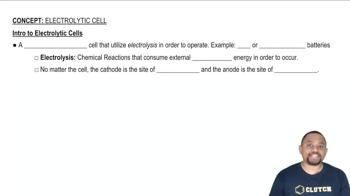
The Electrolytic Cell
Anode and Cathode
In an electrolysis cell, the anode is the electrode where oxidation occurs, meaning it loses electrons. Conversely, the cathode is where reduction takes place, gaining electrons. In copper electroplating, copper ions from the electrolyte are reduced at the cathode, while copper metal from the anode dissolves into the solution, providing a continuous supply of copper ions.
Electrolyte Solution
An electrolyte solution is a medium that contains ions and can conduct electricity. In electroplating, the electrolyte typically contains metal salts, such as copper sulfate, which provide the metal ions needed for deposition. The concentration and composition of the electrolyte influence the efficiency and quality of the electroplating process, affecting factors like deposition rate and surface finish.
Recommended video:
Guided course
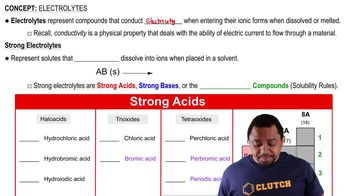
Electrolytes and Strong Acids
Related Practice
Textbook Question
2188
views
Textbook Question
Write equations for the half-reactions that occur at the anode and cathode for the electrolysis of each aqueous solution. a. NaBr(aq) b. PbI2(aq) c. Na2SO4(aq)
1
views
Textbook Question
A major source of sodium metal is the electrolysis of molten sodium chloride. What magnitude of current produces 1.0 kg of sodium metal in 1 hour?
1055
views
Textbook Question
Write equations for the half-reactions that occur at the anode and cathode for the electrolysis of each aqueous solution. b. KCl(aq) c. CuBr2(aq)
Textbook Question
Write equations for the half-reactions that occur at the anode and cathode for the electrolysis of each aqueous solution. a. Ni(NO3)2(aq)
3029
views