What products are obtained in the electrolysis of a molten mixture of KI and KBr?
Ch.19 - Electrochemistry
Chapter 19, Problem 96b,c
Write equations for the half-reactions that occur at the anode and cathode for the electrolysis of each aqueous solution. b. KCl(aq) c. CuBr2(aq)
Verified step by step guidance1
Step 1: Identify the ions present in the aqueous solution of KCl. In KCl(aq), the ions are K⁺ and Cl⁻. Water (H₂O) is also present and can participate in the electrolysis reactions.
Step 2: Determine the possible half-reactions at the anode for KCl(aq). At the anode, oxidation occurs. The possible reactions are the oxidation of Cl⁻ to Cl₂ gas and the oxidation of water to oxygen gas.
Step 3: Write the half-reaction for the oxidation of Cl⁻ at the anode: 2Cl⁻(aq) → Cl₂(g) + 2e⁻. This reaction is more favorable than the oxidation of water under standard conditions.
Step 4: Identify the ions present in the aqueous solution of CuBr₂. In CuBr₂(aq), the ions are Cu²⁺ and Br⁻. Water is also present.
Step 5: Determine the possible half-reactions at the cathode for CuBr₂(aq). At the cathode, reduction occurs. The possible reactions are the reduction of Cu²⁺ to Cu(s) and the reduction of water to hydrogen gas. Write the half-reaction for the reduction of Cu²⁺ at the cathode: Cu²⁺(aq) + 2e⁻ → Cu(s). This reaction is more favorable than the reduction of water under standard conditions.

Verified video answer for a similar problem:
This video solution was recommended by our tutors as helpful for the problem above.
Video duration:
3mWas this helpful?
Key Concepts
Here are the essential concepts you must grasp in order to answer the question correctly.
Electrolysis
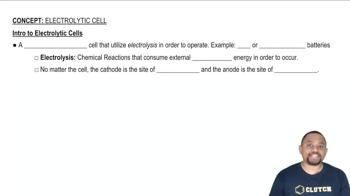
Electrolysis is a chemical process that uses electrical energy to drive a non-spontaneous reaction. In this process, an electric current is passed through an electrolyte, causing the decomposition of the compound into its constituent elements. The reactions occur at two electrodes: the anode (positive electrode) and the cathode (negative electrode), where oxidation and reduction reactions take place, respectively.
Recommended video:
Guided course
The Electrolytic Cell
Half-Reactions
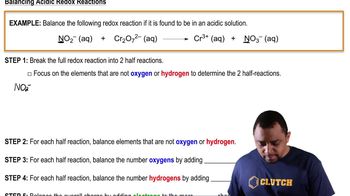
Half-reactions are the individual oxidation or reduction reactions that occur at the electrodes during electrolysis. Each half-reaction shows the transfer of electrons and the change in oxidation states of the species involved. By writing half-reactions, one can clearly identify what is being oxidized at the anode and what is being reduced at the cathode, which is essential for understanding the overall electrochemical process.
Recommended video:
Guided course
Redox Half Reactions Example
Electrolyte Solutions
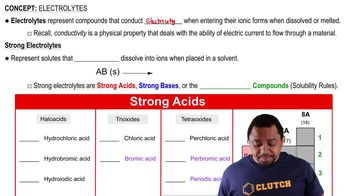
Electrolyte solutions are aqueous solutions that contain ions, which are necessary for conducting electricity. The nature of the electrolyte affects the products formed during electrolysis. For example, in KCl(aq), chloride ions can be oxidized at the anode, while in CuBr2(aq), copper ions can be reduced at the cathode, leading to different half-reactions based on the specific ions present in the solution.
Recommended video:
Guided course
Electrolytes and Strong Acids
Related Practice
Textbook Question
1080
views
1
rank
Textbook Question
Silver can be electroplated at the cathode of an electrolysis cell by the half-reaction: Ag+(aq) + e– → Ag(s) What mass of silver would plate onto the cathode if a current of 6.8 A flowed through the cell for 72 min?
2188
views
Textbook Question
Write equations for the half-reactions that occur at the anode and cathode for the electrolysis of each aqueous solution. a. NaBr(aq) b. PbI2(aq) c. Na2SO4(aq)
1
views
Textbook Question
Make a sketch of an electrolysis cell that electroplates copper onto other metal surfaces. Label the anode and the cathode and indicate the reactions that occur at each.
887
views
Textbook Question
Write equations for the half-reactions that occur at the anode and cathode for the electrolysis of each aqueous solution. a. Ni(NO3)2(aq)
3029
views